Sunday, May 28

Jodie Foster Loses Herself


The thought of Natalie Portman gangsta rapping was cute, but what if Jodie Foster gangsta raps like Eminem? I like Eminem, but Jodie Foster losing herself? Scary thought, ei?

Here's the YouTube description of the vid: "At the UPenn's 250th Commencement Jodie Foster, the guest speaker, quotes Eminem from his song "Lose Yourself" with a message for the graduates."

/

100% Perfect Girl


One Sugar Dream made a black and white comic based on Haruki Murakami's short story "On seeing the 100% perfect girl one beautiful April morning."

If you wanna spread some love and have Y1800 to spare--that's Y1000 for the comic plus Y800 for the shipping--please hurl it in one direction. You can order online and pay via Paypal.

Then I will heart you forever, or until they come out with a comic for "The Second Bakery Attack" or whichever comes first. Promise.

Friday, May 26

Bollywood Calling

The Observer notes that call centers have become part of the cultural mainstream. It has also "become symbol for the rapid change India is going through," a picture of a nation caught between two eras.

There are around 350,000 workers in this industry, most of them young and college educated. Working in a call center assures one of a higher than minimum wage salary, and is often seen as glamorous, but "for sheer monotony, few office environments can beat the deadening tedium of the call centre, where workers spend long shifts repeating pre-scripted phrases to faceless customers."

Nevertheless, the call center serves as the backdrop for novels, soap operas, and film. Makarand Paranjape of the Jawaharlal Nehru University explains this phenomenon: "Literature is just catching up with social trends - and now we're seeing an attempt to eroticise the industry, an attempt to make it a culturally exciting place, hip and cool. Of course it's a bit of a fantasy: there is nothing glamorous about call centres; they are dehumanising, decultured places."

The Indians have expressed their grief at this situation clearly enough. Varun (or Victor), the lead character in "One Night @ The Call Centre" says: "My friends, I am angry. Because every day I see some of the world's strongest and smartest people in my country. I see all this potential, yet it is all getting wasted. An entire generation up all night, providing crutches for the white morons to run their lives."

I'm not sure about the exact figures, but I think we also have more or less the same number of young people who work in call centers. People see outsourcing as a sunshine industry, nevermind that our young and brilliant people are doing a mind-numbing job. People get paid, they get to speak in an American accent. What more can you ask for, right?

I wonder how long it'll be before we get a film, novel or tv show that uses the call center as a major backdrop. Yeah, there was that Bea Alonzo-John Lloyd movie where Bea is supposed to be a call center agent, but Now That I Have You never really used that in the story except as a minor detail. There was also Keka where Katya Santos' character also worked in a call center. I suppose that's how she got to kill people without anyone noticing. Hehe.

So I guess this means the call center thing is still one huge open field. Makes me think of revising an old work set in the dark ages when people still carried pagers and it was a cool, cool thing to own. Weh.

Thursday, May 25

Les fantômes d'Escolta

In case you're interested, there's going to be a documentary on Philippine Cinema made by the French showing on TV5 Monde (please check your local cable listings.) It's supposed to air this at 16h57 (or 4:57pm, whatever) and part of the Cannes 2006 specials.

From what I can gather, the piece deals with stuff we already know: that Pinoy cinema is dead, killed by exorbitant taxes and old habits. It traces the rise and fall of the film industry in the Philippines. At the start of the 80s, studios in Manila and Cebu produced as many as 200 films annually, but today they make less than 50. The film industry in the Philippines was once one of the more prolific in the world, next only to Hollywood and Bollywood.

But the rise of piracy and DVDs only seemed to announce the end. And with the death of the country's most celebrated actor Fernando Poe, Jr. in December 2004, Renaud Fessaguet examines the state of film in the archipelago. Is it dying or dead? The crisis continues, but on the other hand, it seems to permit the inclusion of new talents, independent productions and daring new stories.

Now, you will have to excuse my really rusty French. I might have misunderstood the entire thing so in case I got things wrong, I'm posting the forwarded information about the documentary below:
"Les fantômes d'Escolta" – Réalisateur : Renaud Fessaguet - 2005 – 52 min (France)

Le cinéma philippin se meurt, écrasé par des taxes exorbitantes, de trop vieilles habitudes et un enfermement provincial devenu fatal.

Jusqu'au début des années 80 pourtant, les studios de Manille et de Cebu produisaient plus de 200 films par an, aujourd'hui ils en sortent moins de 50. L'industrie cinématographique de l'archipel était l'une des plus prolifiques du monde, après la Californie et Bollywood.

Puis vinrent le piratage et le DVD, implacables virus qui en annonçaient la fin. A l'occasion de la disparition du plus célèbre des acteurs philippins, Ferdinand Poe Jr., en décembre 2004, Renaud Fessaguet se penche sur le cinéma de l'archipel. Moribond, mort ? La crise traversée semble au contraire permettre l'éclosion de nouveaux talents, de producteurs indépendants et de scénarios audacieux.

Le 24 mai 2006 à 16h57 sur TV5 Monde.

Wednesday, May 24

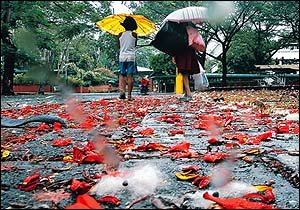
Weird This Day

Photo swiped from the Inquirer

Days like this, when elsewhere seems like an interesting option, I have to remind myself why I'm still here.

Dan Rhodes' Top Ten

Dan Rhodes provides us with his literary top 10.

He likes Chekov (#1), Flannery O'Connor (#10), and thinks that everyone in school deserves to know how we are being systematically hoodwinked (#2). This last one is a staple in my research paper writing classes.

And because I was googling like mad, click here are more excerpts--Face, Lost, Herself, Mold--from his book Anthropology. My favorite from that collection was the last story "Words" and that one where the girl was named Tadhana.

/

Tuesday, May 23

Blogworth


My blog is worth $12,419.88.
How much is your blog worth?


Not that I care much, or that I'll ever cash in on that twelve grand.

Monday, May 22

William Boyd's short history of the short story

William Boyd provides us a quick taxonomy of the short story. He tells us that the modern short story as we know it now is mostly an American device which blossomed with the arrival of mass produced magazines and papers, and at its height in the 1920s, writers like F. Scott Fitzgerald received as much as $4k for a single story published in the Saturday Evening Post.

But although short fiction is an American enterprise, it was Chekov who revolutionized the narrative:
“By abandoning the manipulated beginning-middle-and-end plot, by refusing to judge his characters, by not striving for a climax or seeking neat narrative resolution, Chekhov made his stories appear agonisingly, almost unbearably lifelike.”
So almost everyone writing short fiction owes something to Chekov. But if you do not subscribe to the singularity of effect that characterizes the Chekovian variety of short fiction, then you must be following the event-plot tradition, which according to Boyd, refers to the “style of plotted story that flourished pre-Chekhov—before his example of the formless story became pre-eminent.”

But since the 1950s, writers have attempted to deviate from the Chekovian form. There’s the “suppressed narrative” which can be seen in the works by Borges, Nabokov, and Calvino. There’s also the mini-novel story which attempts to compress within a few pages what the novel does in a few hundred.
Then there’s that weird creature which Boyd calls the biographical story:
...a catch-all term to include stories that flirt with the factual or masquerade as non-fiction. Often the impedimenta of the non-fiction book is utilised (footnotes, authorial asides, illustrations, quotations, font changes, statistics, textual gimmickry).
Proponents of this style include Dave Eggers, David Foster Wallace, Jonathan Safran Foer. Also, “the biographical story also includes stories that introduce real people into fiction or write fictive episodes of real lives.” This new incarnation of the short story seems to be the only logical development of living in a world saturated by “advertising media, the documentary, journalism, and 24-hour rolling news, to colonise some of that territory, to invade the world of the real and, as a cannibal will devour the brain of his enemy to make him stronger, to make fiction all the more powerful by blurring the line between hard facts and the invented.”

This collision between reality and fictional reality seems to be unifying theme of contemporary literature (and that also extends to film). It’s the question that everyone asks of his or herself: “Why am I here? Is this really happening? How did I ever get here?”

Saturday, May 20

Barbie Rocks the Big Dome Concert Playlist


Just got back from the Araneta. The concert was supposed to start at 8pm, but front act Salamin actually came onstage at around 9pm, and Rocksteddy did 5 or 6 songs--enough to make you think you went to the wrong event.

But once you look at the stage, there's really no mistaking that this must be the Barbie concert. They really played up the girlishness of the whole thing, complete with a dollhouse set, a flully pale pink debutante gown and like 3 costume changes. And oh, there was also a revelation involved. What that is, the clue is in the playlist. Detailed comments sometime this weekend.

Meanwhile, here's the playlist:

1. Tomorrow (debutante gown ripped off)
2. Torpe feat. Teddy of Rocksteddy, formerly known as Andres Bulate ("Lagi mo na lang akong dinededma")
3. Tabing Ilog
4. High feat. Ney of 6cyclemind
5. Himig Natin by Teddy and Ney (costume change)
6. Salamat by Teddy, Ney and Barbie
7. Overdrive
8. Just a Smile
9. True Colors
10. Time After Time
11. Limang Dipang Tao
12. Bulong by Kitchie Nadal (costume change)
13. Majika by Kitchie
14. Firewoman by Kitchie on vocals/guitar, Barbie on piano
15. Same Ground by Kitchie and Barbie
16. Untitled Engagement Song
17. Dahilan
18. Parading
19. You Learn feat. Mrs. Almalbis
20. Sweet Child of Mine
21. Living on a Prayer
22. I'm the one who wants to be with you
23. Summer Day
24. Encore: Goodnyt (Remixed with Twinkle, Twinkle, Tomorrow and some praise song)
25. 012**

**I think this was the real last song of the night, but I could be wrong.

Thursday, May 18

Retro Loco

TV Cream has the very best of TV themes from shows you grew up with. I loved the talking car in Knight Rider. When the "Bilog Ang Mundo" campaign came out, I swear that's the Knight Rider theme thrown into the mix.

He-Man recently outed. "By the power of Gayskull"? Didn't Joey de Leon do this way way back, as in, "She-Man: Mistress of the Universe?"

Joey de Leon as She-Man

The International Hero website traces She-Man's history:
Pando is a blacksmith who dreams of becoming a superhero. One day his dream is granted by a gay hermit Gayskull, who transforms him into a hero, so that he can rescue kidnapped Barrio children from the evil Skeleton. However because of Gayskull's sexuality, his spell turns Pando into She-Man, a gay superhero who rides a butterfly into battle.
It's a He-Man and Panday satire--doesn't that kick ass? And this is way before Zaturnnah and the giant palakang kokak.

You can also look at the She-Man movie synopsis here.