Thursday, April 27

Slayage Verbage

Slayage, the International Online Journal of Buffy Studies(!*), pointed me to the Buffy Studies Bibliography, where I discovered this essay about how Willow, the middle Scooby child, is somehow not all grown up yet. (I wonder if this really explains everything post-Tara, including Kennedy--but that's another matter). Here's a paragraph from the essay from Jes Battis about Willow as Hybrid/Hero:
Like all serial shows, Buffy relies upon the concept of sameness. Unlike most serials, it constantly calls this sameness into question, challenging its own programmed structure as a media vehicle that must obey certain popular themes—it may obey them, but not transparently, and not without visual and narrative resistance. Umberto Eco’s description of the serial as a constant narrative that gives the illusion of change, and within which “the secondary characters must give the impression that [their] new story is different from the preceding ones, while in fact the narrative scheme does not change" (Eco, Limits 86), is both applicable to and resisted by Buffy. Repetition gives a show emotional currency with its audience, for by rehashing the same scenarios, it “consoles us (the consumer), because it rewards our ability to foresee: we are happy because we discover our own ability to guess what will happen” (86). And in this sense Buffy conforms to Eco’s model, for every season presents us with the same core group of characters (Buffy, Willow and Xander) who are visited by alternating supporters (Anya, Oz, Riley) detractors (Adam, Glory, and most recently the First Evil) and ambivalent characters like Spike, who straddle the line between protagonist/antagonist in ways that continually disrupt the audience’s perceptions.
I'm a movie and film geek. I'm also a regular school geek, but not like that. I mean it's one thing to enjoy watching Buffy and turn it into something more, uh, academic. But this almost convinces me about Barako Cafe's observation that the academe breeds bad writing. Here's more:
Extra-textual ramifications aside, it is Tara’s death that fragments Willow’s already-compromised identity beyond repair, causing her to become wholly subsumed and embodied by magic. At first her goal is simple—kill Warren, who is directly responsible for the shooting, and also his friends Jonathan and Andrew, who are guilty by association. But after her first kill—a gruesome act of disembodiment, in which Warren is actually flayed—Willow’s plans grow more abstract. While supposedly pursuing Andrew and Jonathan, she spends most of her time challenging and subverting her surrogate family—the Scoobies—by excavating their fears and undermining their accomplishments. (6019; 21; 22). Willow does not need magic to do this. Magic gives her the voice, the confidence, but it is through ordinary speech acts that she violates and tears down her friends. This psychic battle culminates in a physical one with Giles—whom she accuses of being "under the delusion that you [are] still relevant here"—wherein she brings him close to death, and extracts the magical power that he has ‘borrowed’ from a Coven; the power allegedly meant to contain her (Buffy 6022). This confrontation will ironically be recast as a teacher/student relationship in Lessons (7001), as Giles attempts to teach Willow focus and control over her power. The rhetoric that he employs, however, is merely a positive, slightly Gaian spin on what Willow has already enunciated: "I am the magic." Giles can never truly teach her what this ambivalent relationship means, how it must be maintained, or how it will transform her.
And the paragraphs I cited are more or less "tame" and still easily understood. What more the real hardcore subject-position-the-other-


*Notice how I like using "!" a lot these days. Haha.

Peaking at 10

In this photo, Anna Chlumsky has a very eerie resemblance to the 1995 Alanis Morissette. Don't you think?

Earlier this year, Macaulay Culkin came out with a semi-autobiographical book. Now his "My Girl" co-star Anna Chlumsky writes about the difficulty of "making it" after age 10:
I had been given a big wide glimpse of what VH1 tells you “making it” is. But in order to realize what my version of “making it” would be, I’d need to purge theirs. By the end of high school, it had grown painful to want something so bad and seem to get so little in return for my efforts. I could barely look myself in the zit-magnifying mirror, let alone tackle an entire industry that thought I wasn’t good enough.
....
Success at a young age not only gives you a taste of grandeur and attention that you forever strive to duplicate, but it also gives you that precious sense that you can achieve absolutely anything. The trick is to learn how to let the past drive you to your next, bigger, and better peak. I know it will be a harder road than ever before. It’ll be something more akin to the vigorous path trod by the Vaudevillians than to the lucky break I got at age 10.
So Anna Chlumsky quit her job editing sci-fi stories (!) to follow The Great White Way. We wish her well.

I suppose this is the curse of all child actors. The difficulty of convincing people that hey, you're all grown up. I wonder what it's like for LA Lopez. The iodized salt did him in.

Sunday, April 23

Real Women Have Curves

Real Women Have Curves is about Ana, who recently turned eighteen, and is the daughter of first generation Latin immigrants. While she’s managed to finish high school at an elite Beverly Hills institution, her mother has signed her up for a bleak summer working at her sister’s garment factory, where they put together beautiful clothes they’ll never be able to afford once it hits the stores. Ana refuses to believe that this is going to be her life, and takes on her English teacher’s offer to help her get into college at Columbia University. She has also sneaking out to dates with Jimmy, who happens to be white, but also steadfastly says that no, Ana’s not fat, but beautiful. This little romance is a little bit too textbook progressive feminist: Ana slips into a drugstore to buy a cigar for her abuelo, then asks for condoms; she goes home with Jimmy and tells him, it’s okay, she’s ready, and later, without hint of remorse and wailing, they say goodbye because they’re going off to college. The day after Ana sleeps with Jimmy, her mother sees her examining herself in the mirror. Immediately, they have this huge argument. Here is Old World vs New World: Ana’s feistiness and refusal to be contained in her mother’s ideas of how a (Latina) woman should behave, the mother hindering her own daughter’s education because she wants to preserve the family. Surprisingly, it is the father who finally convinces the mother to let Ana go. On the day Ana was to leave for New York, the mother did not see her off. Nevertheless, when we next see Ana emerging from the subway station, she has a smile on her face, and we know that everything’s going to be okay.

The movie reminds me somehow of Spanglish, which I finally got to see video. The same device was used as bookends: of a Latina girl gaining admission to an elite college. In Spanglish, it was the contents of the girl’s application essay that we hear: how her mother did everything she could to give her the good life in this new land. Again, it was a tug of war, surrending a few things from the Old World to acquire more acceptance into this New World. Both stories featured a mother-daughter relationship. In Spanglish, the pair leaned on the slim and exotic side, and it was the American daughter who waged a war with the bulge.
The females in Real Women are as real as you can go. There’s a scene where the heat in the factory lead the women to take off their clothes, displaying girdles and granny panties, cellulite and stress marks. The daughter in Spanglish was played out as an innocent fawn, and her mother was also more yielding, gifted with this mysterious way of understanding even without words—a quality that their counterparts in Real Women Have Curves sort of lack. It was forever skirting the danger of having characters you wouldn’t really like: too harsh, too passive, too loud, too curvy. It’s interesting to note that when the filmmakers put out a casting call for girls who are either “fat” or “overweight.” Most of the girls who came to audition didn’t have too much meat on their bones, and yet believed they should lose weight. America Ferrera, who finally got the part, delivered a quite remarkable debut performance. Her Ana knew what she wanted and would do everything to get there. She was walking a very thin line. Nevertheless, it just goes with the unapologetic stance it has taken from the start. Real Women Have Curves. Either you deal with it or not.

The heat is on

Got marooned at home and in front of the television yesterday. Watched some Veronica Mars, where I had an America’s Next Top Model sighting. Or at least, I think that was Naima Mora playing a cameo as the teacher Miss Dumas (or "Dumbass" as one kid said) in the bus.

On that note, let me whine a bit because I missed the season finale of Top Model and Project Runway because I was marooned in an island. And I just read that Janice Dickinson, the world's first supermodel, started her own agency. Aren't you scared yet?

Anyway, I spent most of Saturday indisposed and/or vegetating. Will write about movies I saw this week, if I still have time. Busy week coming up.

Tuesday, April 18

iblog2

If you're not doing anything, you might want to check out The 2nd Philippine Blogging Summit today, 18 April. It'll be held at the UP College of Law (Malcolm Hall) from 9am to 5pm.

I missed last year's summit because there were things to do. This year, there are still things to do. But I'm crossing my fingers that I'll be able to drop by. There are several panels I want to check out. Now if only I can be in several places all at once.

Monday, April 17

Imagine me and you and me

I was reading a report about this year's Cinema One entries which apparently include something that reminds me of this movie and something that reminds me of this blog post.

Hmm.

Sunday, April 9

Advisory for the Wholly Weak

xkg wishes to inform everyone that there will be no updates in this blog for the next two weeks. She's spent the last three weeks checking papers and tallying grades, and the past year working nonstop. She's decided to throw in the towel in her backpack and maroon herself in an island--at least for the next week.

This is also her vain attempt to rest while trying to finish her own school requirements and other projects. She's going to read this and this. At the very last minute, she ran out to the record store and got this. She still doesn't have sunblock, but what the hey.

She's also hoping that history won't repeat itself. Have a nice vacation everyone!

Wednesday, April 5

On the Question of Filipino Identity


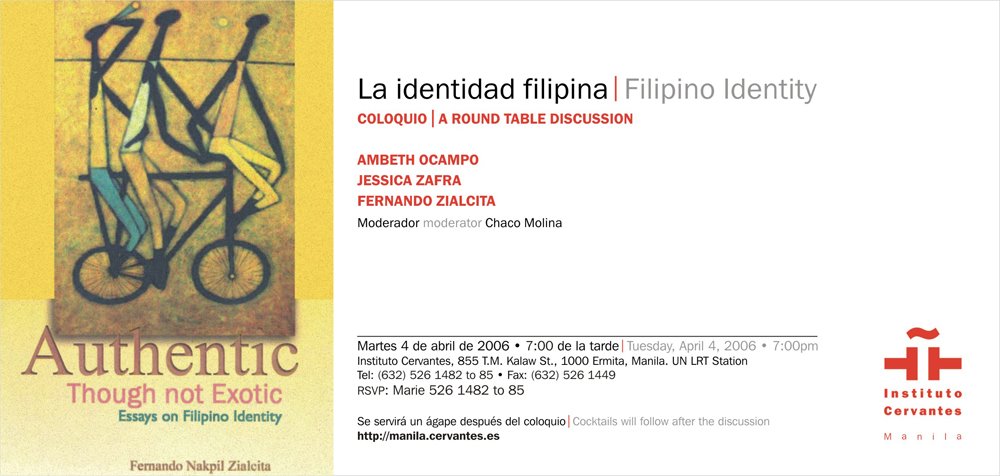
Managed to attend a roundtable discussion on Filipino Identity at the Instituto Cervantes. I had to squeeze it in between footspa and paper checking and literally had to squeeze through shelves and a huge crowd. There was no round table and there were lots of people and they had to bring in more chairs to accommodate everyone.

I was also lucky enough to arrive at the venue on time. The footspa took longer than expected and I had to leave before I could have a pedi, but I managed to get a cab in under 20 minutes and sailed through Manila, turned right at Quirino Avenue, rounded the corner to Plaza Dilao, another right at UN Avenue, right turn to Taft and another right turn to Kalaw. All this in ten minutes, yey! (And yes, I realize this makes me sound like a ditz and an airhead, but anyway.)

The anthropologist Fernando Zialcita presented his book "Authentic Although Not Exotic," which was actually a collection of essays on Filipino Identity. The flyer advertised "the historian Ambeth Ocampo" as part of the panel, but in the end, the participants included Zialcita, Isagani Cruz and "the journalist Jessica Zafra," who came "underdressed" in a Darna t-shirt.

The panel was to address the huge question: What makes us Filipino? There's also the question of culture, of the tangible things that somehow make up our sense of selves. He clarified certain myths, like that of the Barong Tagalog, and of how in that huge conference in the 90s (was it the APEC conference?), there was this photo op wherein all the Asian leaders wore a barong and the Bangkok Post said it was a bad signifier, as the barong was "a slave shirt." This "barong-is-a-slave-shirt" myth was somehow popular as some "natives" were asked about why the fiber used for the barong was translucent, these said locals replied, "So they can check if you have a weapon hidden underneath. They also claimed that there was a law passed by the cortes in Spain that the indios not only had to be "x-rayed" for concealed weapons, but they also had to wear their shirts untucked, which was like an insult in those times. Zialcita disproved this notion, saying that Asians--like the Chinese and Indian people, tended to wear their shirts loose and untucked. He also added that the piƱa cloth was actually an innovation. Pineapples were imported from Mexico and the Pinoys thought, hey, we can turn this into really nice fiber. So the barong as we know it is really not Spanish in origin, but a mixture of ideas welded into one.

Which leads us to the next point: Pinoy culture is not handed down from the Spanish, and it's also not the "tribal" thing that some people insist we go back to. Pinoy culture is actually mestiso culture. (I hope I got this right.) A lot of people think that when you say "mestiso," it means "half-breed," as in half-Spanish, half-indio, or half-Chinese, or half-whatever. (We're not even bringing in that "half-Filipino, half-Filipina" definition. Hehe.) Which in turn makes people think that what we have is actually a "bastardized" culture, and hence we shouldn't be proud of it, or let's go back to that "pure" culture we had before the Spanish came.

Zialcita again points out that there no such thing as pure anymore. Mestiso actually means "mixed" or "from different origins." A fusion, really. So there's no point in trying to eradicate the culture that we know now, the dominant "Tagalog low land Catholic" way of living, because what the others are yearning for, that "pure" pre-Spanish, alibata-writing, and datu-headed, near-river-dwelling way of living is now lost. You can't efface 300 years.

This is where my Charlie Kaufman theory of understanding culture comes in. See, the people who want to revert to the nativist claim, the pure pre-Spanish way of living are like the people who go to Lacuna Inc and have their memories erased. But I don't think it's going to be effective. What happened is already indelible. We will still cook adobo with vinegar and soy sauce, nothing like the Latinate adobado. I don't think people will want to revert to the alibata. While it might look cool as a henna tattoo on your arm, try using it on all your documents or have the street names and everything converted to it. It'll be like effacing your entire life and relearning it, and then discover that what you just wrote in alibata script is "D2 na me."

More on this when I have time, after more checking, laundry drying and trying to catch my ride to the highlands. And yeah, muchos gracias to saturatedtextmachine for twisting my arm to go the lecture.

Tuesday, April 4

Originality

GMA Films decided to rebutt certain "reports from tabloids" that their film "Moments of Love" was based on 2 Korean movies--Kim Jeong-kweon’s “Ditto” and Lee Hyun-seung’s “Il Mare.” This is what GMA Films president Annette Abrogar had to say:

"We never claimed it was an original concept. From the very start, we said that the movie was inspired by ‘Somewhere in Time.’ We just presented it in a manner that the Filipino audience would like best. I think we were misinterpreted when we said that ‘Moments’ is an extraordinary story,” Abrogar told Inquirer Entertainment. “Maybe people thought that we meant the story was original. What we wanted to say was that the movie was not your usual love story [but not that] we invented it.”

True, you can't reinvent the wheel. But I always thought that if you're not going to be original--which is hard to do, there must be like just one or two original stories in this world and we just recycle it everytime. You can ask Joseph Campbell on that. But then again, if you're going to copy or "get inspired" by something, you might as well make it memorable.

Wish could say something more. But I just don't have the right amount of braincells working at the moment to construct a proper reply.

Monday, April 3

The Great Bee Is Watching

I finished tabulating grades for another class tonight. Two down, two to go. Yey! As a reward for myself, I trolled around online a bit and found two variations on the same thing:

Photo swiped from Adel Gabot's lj

photo from paolomanalo's flickr

The first is swiped from the Electric Journal of Adel Gabot. I suppose if Jollibee owner Tony Tancaktiong decides to venture into the coffee business like McDonald's did with McCafe, he can call it Jollibean. But apparently someone in Singapore already beat him to it. Unless this really is part of the Jollibee empire.

The second photo is by Paolo Manalo,, who spotted it in Baguio, where he's currently taking part in the UP National Writers Workshop.

It's 2006 and a giant bee is watching us. Maybe we should all run for our lives.