Why, take this online flash quiz to see if you're smart, of course.
Luckily, it turned out that I'm 24.7% smarter than the average. Not that I'm too thrilled by that. But after several days of writing, I'm glad that I still have some grey matter left.
Monday, January 29
Thursday, January 25
Frilled Shark

For this post, I will let CNN's own report highlights do the talking:
• Rare frilled shark videotaped by staff at Japanese marine park
• Shark normally lives at least 2,000 feet below the sea
• Scientists believe it came to shallow waters because it was sick
• Shark died shortly after it was caught
The frilled shark is supposed to be a carryover from ye olde days--it's really almost prehistoric that the scientists call this species a "living fossil." When they said "frilled," I had in mind a shark wearing ruffles and frills, like Lenny in Shark Tale or something. But look at that mug, doesn't it remind you of dinosaurs?
On another note, what's up with these Japanese scientists? It seems like they've been busy filming weird creatures from the deep. Or perhaps, what is it with the waters south of Tokyo? Last month it was the giant squid. Now an ancient shark. Maybe next month we'll have a face-to-face encounter with Godzilla na talaga. Nyar.
Happiness = Big Macs + iPods
An Australian bank came up with a new way of tracking international currency values using the cost of an Apple iPod as a benchmark.
Previously, the Economist came up with measuring this same thing by looking at the prices of Big Macs all over the world.
And still before that, I remember reading about how another group tied up the price of a can/bottle of Coke to the happiness index of countries. Meaning, that if a can/bottle of Coke is affordable to the citizens of that country, then there's a bigger chance that those people are happy. The suggestion is perhaps that they have more money for food and a little money for things like Coke, which isn't really a staple food. Unless you classify sugar as a staple food.
The Big Mac index isn't too far from the happiness and Coke theory, if we're measuring the affordability of fast food is in certain countries. The cheapest Big Mac to be had is in China -- $1.30, compared with an average American price of $3.15.
The thing with this iPod index is that it's no longer just fast food or a fizzy drink, you're really measuring how much disposable income do countries have when it comes to technology. I'm not sure about the equation "have iPod, am happy."
Wednesday, January 24
The Vintage Contemporaries Reader

My book # 2 for 2007 is The Vintage Contemporaries Reader. I''ve already read some of the stories here elsewhere, like the the opening chapter from Jay McInerney's Bright Lights, Big City, which I really liked. There's also David Guterson's "Piranhas" and excerpts from Sandra Cisneros' House on Mango Street.
But I'm really pleased with my new discoveries, however admittedly late in the game, like Ann Beattie's "What Was Mine," where a man goes to pick up some things which an "uncle" left him in his will. What amazes me is the economy and fluidity of the story. How it builds a world and the relationship of the people in that world.
I also liked Raymond Carver's "Why, Honey?" where a mother recalls the acts of a son which were suspicious at the time, but she didn't have the heart to confront him. Now that she's in danger, there's that palpable sense of threat and she can only ask why though perhaps it's already too late.
The anthology gives you a good look at the fiction produced in America in the last couple of decades, and I suppose it's just fitting that it closes with a story from McInerney, "How It Ended." It is a fitting end, though the story asks you to really suspend disbelief about a former golden boy who has escaped drug dealing and prison in Cuba and now wants to be a lawyer. All in all, a very good read.
Blow
Don't look now--or maybe you should look now, and be careful--but blow drying is back "after the big hair boom of the early 80s."
This Guardian article by Paula Cocozza traces the blow dry's fall from grace since then: the introduction of the shampoo+conditioner in the late 80s designed to speed up the trip from shower to street, to the rise of grunge, then came the gradual sneaking in with Jennifer Aniston's Rachel haircut. Cocozza says that the Rachel isn't really about the cut itself but the styling--the focus is on straightening, not volume.
I suppose on this side of the universe, the straightening aspect is more pronounced. There's also rebonding trend since the early 2000s, which I think caught on because of a certain group of Taiwanese boys, and now we have been rebonded to death. But now, I see more girls with curlier hair, or if not that, a more obviously stylized look.
Now don't ask me why I know all this. I myself am not given to sitting down in salon chairs. But every once in a while, it does feel nice to have someone else take care of your own hair. And it's better if the entire thing can be done in the span of time that one conducts a quick text conversation. Danier Hersheson credits the return of blow drying to convenience, a kind of "hairdressing meets Starbucks." The moment a person leaves that chair in a "hair spa," what she gets is her dream hair-something that she didn't think she even had. A blow dry without shampooing costs a hundred in a neighborhood parlor, more if you go to a more established place. But if you are determined, you can find a place that can give you a good hair day for the amazing price of fifty pesos. We acquire glamour for a short period of time and at a good price. Cocozza calls this "the commodification of hair - hair that has been given a name, turned into something we can buy."
The article ends with how to do a great blow dry at home. Cocozza warns us: "Don't touch blow-dried hair." It's as if it will blow up if you do touch it. But if you really must, then proceed with caution as though you're dealing with a landmine: "If you need to get it out of your eyes, flick it by moving your head. If you must touch it, put your hand under the back of your hair and flick from underneath."
Wednesday, January 17
200 calories
What does 200 calories look like? Some wise geeks opened their pantry and clicked their digicams and this is what we get.
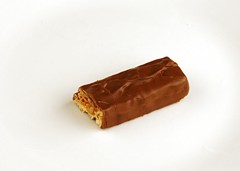
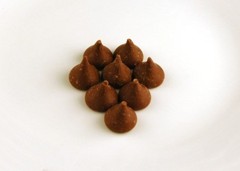
I heart my chocolate too. Too bad they don't have photos of what I really eat.

I'm just like any girl who likes her donut, especially since Krispy Kremes came to town. But looking at their selections, which seemed like you take one bite and all your arteries will freeze and you'll keel over. Anyway, will stick to the glazed, and leave one bite on the plate for an exact 200 calories.
I heart my chocolate too. Too bad they don't have photos of what I really eat.
I'm just like any girl who likes her donut, especially since Krispy Kremes came to town. But looking at their selections, which seemed like you take one bite and all your arteries will freeze and you'll keel over. Anyway, will stick to the glazed, and leave one bite on the plate for an exact 200 calories.
Tuesday, January 16
Seven Signs of the Anti-Aging Apocalypse, Not
I was about to pick up this tube of eye cream when someone tapped my wrists. "What did you do that for?" I said.
"What do you need this for?" my friend said.
"Dark circles under the eyes? Look," I said.
"I don't see anything," she said. "You don't need it." This coming from someone with an entire closet full of skin care products.
Perhaps she's on the right track. Apparently, dermatologists are now advocating a "cosmetics restriction diet," which means going back to basics: get a mild cleanser and an effective sunscreen, then if you're really paranoid about the skin around your eyes or spots, then perhaps a product that caters to that.
Meanwhile, scientists have also identified that part of our brains which tell us we should buy the product. It's the same voice that convinces us that it's not just about having fair enough skin. Now they get you into the program by telling you skin aging starts as early as 23. Sounds effective, because every other ad on television is meant to battle the seven or eight--whatever--signs of early aging.
Heck, it's not even a battle anymore: it's a full scale war. It's not just about skincare products. Everywhere you look, there's bound to be an ad. It's inescapable. What are we to do?
Maybe we should just all close our eyes and say yes to the sunscreen. Nyar.
Tuesday, January 2
The History of the Burgis

Because it's 3am and I'm still up and restless, I decided to post the first book I read for the year: "The History of the Burgis" by Mariel Francisco and Fe Maria Arriola. I got this in one of the bookshops in Cubao X, aka the Marikina Shoe Expo. I've been eyeing it for quite some time, but the price tag kept me off it, until last month I gave in and got it.
Traces the history of social injustice in the country, the evolution of the classes and how the datus became the principalia became the ilustrado became the professional became the burgis, etc etc. Very informative, very fun, with lots of illustrations and stand alone articles. Useful political commentary. Huge chunk devoted to post-war, especially the Martial Law years. May seem a bit outdated since this came out after the first Edsa Revolution, but the non-surprising thing is that most of it still holds: 90% of the population is still poor, and the top 2% still controls the wealth of the nation.
Interesting bit: the peso to dollar exchange rate at the time of Diosdado Macapagal was Php2 = $1. Because of the conditions of the IMF/WB, the peso was devalued to Php3.90 = $1. Why does this sound so familiar?
Sunday, December 24
Giant Squid Live!

A team of Japanese researchers had successfully filmed a live giant squid in the waters of Ogasawara Islands south of Tokyo. The female squid measured 24ft. long and still not fully grown. The scientists, lead by Tsunemi Kubodera of the National Science Museum, said it was relatively small in terms of giant squid standards. "The longest on record is 60 feet," Kubodera said. (O di ba may kung beauty pageant ito ng mga giant squid di siya mananalo dahil bansot siya. Shyet.)
According to this report by the Associated Press, giant squid (genus Architeuthis) are the "world's largest invertebrates. Because they live in the depths of the ocean, they have long been wrapped in mystery and embellished in the folklore of sea monsters, appearing in ancient Greek myths." The giant squid is perhaps related to the myth of the Kraken, or the many-armed sea monster.
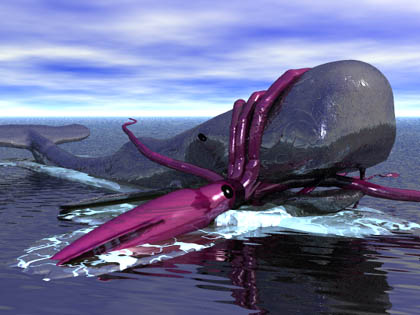
The Japanese team's video is said to be the first. There weren't too many sightings of these giant squid, although its existence is accepted in the scientific community. The researchers also said that the giant squid aren't really going to be extinct, just hard to document since they live really far from the sea surface. But this particular squid they got by following a sperm whale. The report from Washington Post also said that by finding an area where whales fed, he believed he could find the animals. He also said that, judging by the number of whales that feed on them, there may be many more giant squid than previously thought. Here's a photo of a sperm whale fighting off a giant squid:
The news of the squid's capture (and eventual death) brought back memories of reading Jules Verne's "20,000 Leagues Under the Sea." And since it really just had to be Japanese, it made me think of Godzilla or even Shaider. Or the Biomen. Anything with big monsters fighting robots or boys in huge flying mechanical parts.
You can also read more about giant squid sightings here.
Looking for Satrapi
After devouring Art Spiegelman's The Complete Maus (and previously Pekar's American Splendor), I find myself wanting to explore the comic book as autobiography. But just when I've finally decided to get the Marjane Satrapi books, Powerbooks and Fully Booked pulled them out of their shelves. Usually if it's just out of stock, they would ask you to leave your contact number in case they find a copy in another branch. But this time they told me the books are gone because they're not selling. So sad.
In case you know where I can find available copies of Persepolis, Embroideries and Chicken with Plums, please holler or leave a message here.
In case you know where I can find available copies of Persepolis, Embroideries and Chicken with Plums, please holler or leave a message here.
Subscribe to:
Posts (Atom)