"But mostly nothing happens, except in the sense that novelists and short-story writers understand. For them moving a character from not knowing that he’s unhappy to sort of acknowledging it qualifies as a pretty momentous event."
This comes from a New York Times article about the film "Smart People," which is about a depressed professor of literature who has an affair with a former student (played by Sarah Jessica Parker) and lives with his precocious daughter (played by Ellen Page of 'Juno' fame), a good for nothing brother. It was written by Mark Jude Poirier, a fiction writer who now has to reluctantly call himself a "professional screenwriter."
I haven't really seen the movie. Just found the review because I clicked the links related to the reviews of the Sex and the City movie. Apparently, the "depressed academic" is a character that has surfaced in American film in the last few years, with the bar set high by Michael Douglas' portrayal of Gordon Tripp in Wonder Boys and Jeff Daniels in The Squid and the Whale. I saw both of these films and they both happen to feature frustrated academics-slash-writers. If these are the models, then maybe Smart People isn't too far off.
But what really got my attention is Poirier's shift from fiction writing to screenwriting, where generally, things have to happen. The article says that Hollywood had always wooed the big name literary writers--Fitzgerald, Faulkner, Truman Capote--but all these writers just go away puzzled. Hollywood asks them to write stories where a lot of things happen. But what about the epiphany? Epiphanies can be so subtle, if you wink you'll miss it. Poirier is from this school of writing: the only visible change is that the main character now recognizes that he *is* depressed, but acknowledging it doesn't make it any easier. No big transformations, no miracle happy endings.
What the article also makes known is that there really aren't too many fiction writers who can hack the writing of screenplays. Oh there's Larry McMurtry (whose script to Brokeback Mountain I have yet to finish reading), but there's just so few of them. Playwrights have a better batting average. So if the fictionists are having a hard time transitioning to the big screen, what about the reverse: do screenwriters make for successful fiction writers?
Saturday, May 31
Saturday, May 17
But We Need the Eggs

This morning I chanced upon half of Woody Allen's Annie Hall on MGM. One of my favorite scenes there is the one leading to the break up. There's a split screen and we see Annie and Alvy in their respective therapists' offices. Annie is guilty that she's doing well with treatments which Alvy is paying for, and Alvy is stuck still with his own neuroses. The therapists ask them how their sex life is. They're both right on the count: three times a week. For Alvy, that's dismal, for Annie, that's frequent and more than enough. Later, in the plane from California going back to New York, we hear them thinking again. The relationship isn't going very well. Perhaps it would be better if they break up. Alvy agrees. A relationship is a shark, he says. It should keep on going forward. What they have in their hands is a dead shark. So they break up and it's only later, while making a huge stink with the lobsters with the new woman he's dating, that Alvy realizes his mistake. This new woman doesn't see what the fuss is about the lobsters. He gets on a plane and tries to convince Annie to get back together. On a health food cafe in an LA sidewalk, they finally break up.

Last week, also caught the parts of Manhattan. Manhattan starts with the voice of the Woody Allenesque character listing down all the things he loves about the city. What I like about that movie again has something to do with relationships. Isaac breaks up with his 17 year old girlfriend because he's fallen in love with his best friend's mistress. He tells her that she's way too young, and she should pursue acting studies in London. When the mistress goes back to the best friend, he suddenly misses Mariel Hemingway. He runs down New York's streets. But when he arrives outside her apartment building, she's already dressed up and headed to the airport. Isaac's profession of love comes too late, because she's been hurt, and she's now made up her mind to go to London. But if Isaac can wait six months...
I like it that both movies don't force on a reconciliation scene. Well, in Annie Hall, the Woody Allen character writes a play with characters who suspiciously re-enact the scene in the health food store, and instead of walking away from each other, they kiss and make up. But he does say that the things he can't control in life, he can at least correct in his writings. In both Allen movies, the (former) lovers either end up as friends, or they still move in the same small circles that they occupy. In Annie Hall, Allen says that he realizes that the relationships were wonderful while they lasted. As he stands in the street corner after having coffee with Annie, he tells us an anecdote about the man whose brother thinks he's a chicken. The doctor says, Well, why don't you turn him in so we can treat him? The man says, I would have done that, except I need the eggs. It's the worst possible case of can't leave with (it/you), can't leave without (it/you).
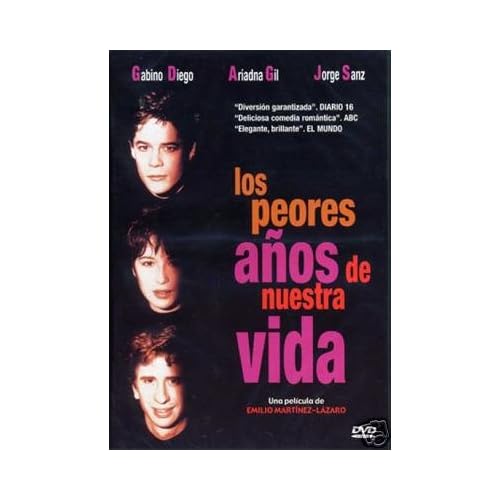
Which brings me to the Spanish film I watched this afternoon, Los Peores Anos de Nuestra Vida, which roughly translates to The Worst Years of Our Lives. It starts with Alberto's voice speaking into a recorder, starting chapter 1 of his novel. It reminds me so much of Manhattan's opening scenes as well. Also, Alberto is the goofy, not quite guapo young man with a more handsome brother and he does remind me a lot of a younger Woody Allen. Alberto's brother Roberto ends up with all the girls, even the ones which Alberto likes. So it comes to no surprise when both brothers fall for Maria, the mistress of a sculptor. Alberto wails and whines that he can't understand women, and though they find him funny, they wouldn't sleep with him. So Roberto gives his brother a hand. Together they plot the break up of Santiago and Maria. They send an anonymous letter to Santiago's wife. Maria gets depressed after the confrontation with Santiago's wife, who tells her empathically that Santiago stays with him, and it's really all for Maria's own good. Maria and Roberto share a kiss, but since Roberto is also busy with his own affair with an older woman, he decides to give his brother and Maria a push in the relationship direction. Then things go wrong, and there are Grand Romantic Gestures in the last few scenes involving a train ticket to Paris and sibling generosity, which I don't quite buy. I mean, real life doesn't afford us any quick turn arounds.
But this isn't a movie concerned with real life. One scene has Alberto watching a romantic movie, and he winces, guys like him don't get the girls in real life, so cinema is just a big piece of crap. The actors get disturbed and even the director turns to Alberto. He is trying to direct a movie, not aiming for cinema verite like De Sica before he got rich. So I guess that prepares us for the kind of ending The Worst Years of Our Lives has.
Which also reminds me that since Woody Allen has probably exhausted all the possible locations in New York, he has turned his gaze on Europe. His next movie is set in Spain, starring Scarlett Johanson, Penelope Cruz and Javier Bardem. Saw the trailer of Vicky Cristina Barcelona in YouTube quite recently.
Monday, May 5
Virtual Age
Answered some questions thrown at me by the Life Expectancy Calculator. If you don't smoke, up a few years. Don't drink much, good. Use seatbelt only on occasion, bad. It's actually amazing to see your virtual age rise and dip with each question answered. I went as low as 19. After 34 questions, turns out my Virtual Age is 22.5 (Hear that belly? Ha, be gone you!). If the average life expectancy for Asians is around 74 years, I can expect to live another 5.5 years beyond that. I have some 18,800 more days to walk this earth, and maybe more if I shape up some.
The Virtual Age Calculator may be downloaded as a stand alone PC program. Sadly, it's a Windows program and not available for Mac.
via
The Virtual Age Calculator may be downloaded as a stand alone PC program. Sadly, it's a Windows program and not available for Mac.
via
The incredible life of elevators
The New Yorker's Nick Paumgarten details the incredible life of elevators and those who make and ride them. The frame story tells about this man who took the longest ever cigarette break--41 hours, most of which he spent inside a stalled elevator. He asked for a beer when he finally got out, and then sued the building and settled for an undisclosed amount. What he didn't bargain for was that the ensuing trauma and law suit left him unemployed and with occasional media attention.
Elsewhere in the essay is a delineation into the kind of research that goes into building elevators. There is a minimum allowable space that a human must have, 2.3 square feet. Women can tolerate much less space, say 1.5 sq.ft, provided that it's mostly women. If men get in the picture, women cross their arms in an attempt to get more space. But the figures are much lower in Asia, where 25 Chinese people will "willingly" squeeze in an elevator meant for 11.
I'd hate to be trapped in an elevator, unless I'm Jeanne Moreau and sharing the car with me is Maurice Ronet in Ascenseur pour l'echafaud, aka Elevator to the Gallows, last viewed perhaps a decade ago in the French Spring film fest.
Sunday, May 4
At the Balay Negrense

This is a photo of Chaka Doll swiped from madmilkmargie, sitting eeriely in one of the rooms of the Balay Negrense, which we visited during our cultural tour of Negros last week. It was raining and the floor boards creaked a bit every time. What's amazing is that the floor boards are all of one piece from front to back of the house, so imagine how huge a tree that was. What's creepy is that this doll, along with some others in what used to be the children's room, stared at us with what seemed like a gash in her forehead. Creepy.
Later, we visited The Ruins, a huge stone house in the middle of the cane fields with the interiors gutted but still absolutely magnificent. According to the caretakers, the guerillas and the owners thought it best to burn the thing so that the Japanese wouldn't use it as their garrison. It took two whole days for the interiors made of hardwood to burn down completely. On one side of the house was a huge window, which used to have floor to ceiling glass, in a room that was specifically for watching the sun go down or up, I forget now.
The descendants of the owners had it fixed up a bit, when they found out that the kids would go there in the witching hours bearing drinks and waiting for ghosts to appear. Now there are little alcoves where you can sit down and eat little sandwiches and drink Cervesa Negra. Imagine living in that house, with ceilings so high and you can twirl around all you like without bumping into any of the solid concrete columns. Run to the veranda or the fountain in the wide front yard. Magnificence, right there.
Friday, May 2
Books Backlog

The book shown above is what broke my self-imposed book purchase ban. I spent an almost monastic week in Bacolod last week. There was very little opportunity to go out--partly because we were staying inside the farthest end of the campus and going out was a chore. When we did have the chance to go out, it was for our various vices--mobile phone loads, cigarettes (not me though), etc. The panelists did take us out for the group discussions. Once we went to Calea, which I heard had great cakes and pastries, although we ended up eating pasta and sandwiches. We were brought to SM Bacolod twice, where we ate bachoy, and we went to the supermarket to gaze at the different kinds of fish for sale. Why we did that, we don't know.
On our second venture to SM, we decided to check out all the book places. The Booksale there had odd price listings--Php67, Php107. Cheaper than Manila prices--movie tickets were Php70 and Forbidden Kingdom was showing. National Bookstore had a small and paltry selection. I got the book shown above though. This copy of Feminist Locations was brand new and still wrapped in clingy plastic. The tag said Php150. I approached the customer service counter to inquire if the price on the tag was indeed correct. When the cashier ran it through their laser checker, the monitor showed it to be worth P72.50. "I'm taking it," I said. Saan ka pa makakakuha ng theory book na worth $25 sa Amazon at heto, wala pa siyang $2? We went back to the campus after this. When asked what we were able to find in SM, the guys just grumbled. I was the only one who got a book, and at a drastically reduced price at that.
Of course, my good intentions were to break it open and read it for my overdue and now lapsed incomplete paper for the gender studies class. I still hope to read it this summer though.
Sunday, April 27
Best Cult Books

I was recently asked what my favorite book was. The question was actually addressed to another fellow sitting on the table, but all of us eventually chimed in. What does it mean, "favorite book"? There are books that one read as a 17 year old and it forever stays with you. Someone owned up to liking Ayn Rand. Another adored Italo Calvino's If on a Winter's Night a Traveller.
The key here, as The Guardian says, is that the sort of book you read early on defines you and takes you for a life turn. It's not just a "favorite" book--it's a "cult" book--the sort "often found in the pockets of murderers; books that you take very seriously when you are 17; books whose readers can be identified to all with the formula '
Browsing the list of books, I saw two which I really did read at seventeen: Sylvia Plath's The Bell Jar and Erica Jong's Fear of Flying. Albert Camus' The Stranger. Then there is J.D. Salinger's The Catcher in the Rye, of course. But that didn't quite hit me as all the teenage girls going crazy or slashing wrists kind of books. Or the "this is the secret to the meaning of life" book. Not in the list is Jostein Gaarder's Sophie's World, beloved of all freshmen who had to take a philosophy class. In the list is The Prophet, which to this day I still can't stand or finish, even after one of the professors in university assigned it as required reading in class.
Thursday, April 17
Abandon the Old in Tokyo
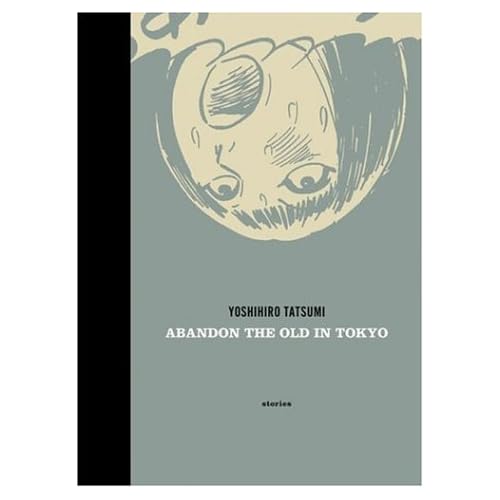
Abandon the Old in Tokyo has eight stories: most of them about working class guys in postwar Japan. There's a factory worker, garbage collector, window washer. In the title story, a young man cooks and washes for his mother, who reminds him without fail that in her youth, she worked really hard to provide for him. There's a flashback that shows the boy accidentally stumbling into his mother and her "clients." And now, in her old age, she thinks she's worked too hard. But a young man can only take the stench of pee-soaked blankets for so long. The young woman she's dating is excited to visit and spend time with him in his apartment. Japan is known for having long life spans and for families taking care of their own elderly, but two decades after World War II, a young man decides to rent an apartment in the outskirts of the city and move his invalid mother there. He must choose: mother or his own woman? Is he doing the right thing? Will it be too late?
In the introduction, Adrian Tomine claims that Yoshihiro Tatsumi predated the naturalist style of recent (say since the '80s) North American comic book artists. I'm not really a big manga fan, but in reading this book, I'm more likely to agree with Tomine. Yoshihiro Tatsumi has more in common with Harvey Pekar or R. Crumb than most of the manga I've read. It has simple enough narratives which capture a day (or days) in the life of someone, and then fades away after an emotional moment. The moments are not big either. When the lonely manga artist was caught drawing graffitti in a public restroom, the look on his face reminded me of Julio Madiaga in the final scene in Maynila: Sa Mga Kuko ng Liwanag. It's desperation pushed against the walls. More Raymond Carver than Ranma or Fruits Basket.
I enjoyed reading the stories. Found this in the big Borders store. I finished it in one sitting, even with a headache. Also, I found out that this was the second in a series--the first being Push Man and Other Stories, which I'll be delighted to read someday. I wish we'd get these titles here in Manila.
Books and Dating
Rachel Donadio writes about love and dating among bibliophiles, or how the books you read may make or break a relationship:
via
NOTE: This post was written like three weeks ago or so. Just posting it now.
Some years ago, I was awakened early one morning by a phone call from a friend. She had just broken up with a boyfriend she still loved and was desperate to justify her decision. “Can you believe it!” she shouted into the phone. “He hadn’t even heard of Pushkin!”Donadio later makes the case that literary tastes may be a gender thing: "Brainy women are probably more sensitive to literary deal breakers than are brainy men. (Rare is the guy who’d throw a pretty girl out of bed for revealing her imperfect taste in books.) After all, women read more, especially when it comes to fiction." I definitely could not stand if all someone read was maybe Zig Zeglar or Who Moved My Cheese?--no offense meant, but that's just not my thing. It won't be the total deal breaker. There will be other things. But I also like Ariel Levy's idea of "compartmentalization": that compatibility in reading taste is a luxury; and that the goal of a relationship, according to her, is “to find somebody where your perversions match and who you can stand.”
We’ve all been there. Or some of us have. Anyone who cares about books has at some point confronted the Pushkin problem: when a missed — or misguided — literary reference makes it chillingly clear that a romance is going nowhere fast.
via
NOTE: This post was written like three weeks ago or so. Just posting it now.
Friday, March 21
Professors Strike Back
Stephanie Rosenbloom writes in The New York Times that professors are now using the web, either via social networking sites, blogs or personal webpages, to reveal information about themselves in the hopes of "becoming more human" in the eyes of students. And there's even a show on mtvu called "Professors Strike Back," which gives the maligned professors to refute the comments in RateMyProfessors.com.
The show has become more popular than the music premieres on that channel. Which only goes to show that for a lot of students, the thought that professors have lives beyond the classroom is almost unthinkable. Sam Gosling, psychologist and associate professor at the University of Texas at Austin, narrated an anecdote where a female student saw him in the street near the campus and looked absolutely horrified. "Like, ‘Wait a minute, you have a life?’ The idea that I would continue to exist — it was sort of a violation of her expectations.” Gosling goes further to say that students today think professors are not doing their jobs unless they convey information in zany, interactive ways.
Teaching has lost some of its god-on-the-podium status. To teach these days means also means to entertain. It's such a taxing demand, to relay information and to make like a talk show host at the same time. What matters is the ability to teach. But students seem to be under the impression that learning is like being part of a talk show audience. "Here we are now, entertain us," and if you fail to do so, you get comments on evaluations like, "Bring a pillow."I tend to agree with the article that this is an unfortunate trend, this need to know that your professor likes Project Runway or has climbed the rockface in Galera. Some are of the opinion that knowing these little things make for a more comfortable learning experience. Whether the "humanization" of professors come in the form of dishing out jokes or crazy anecdotes along the lines of "I have a life, too, you know" or posting more of the same in blogs or social networking sites, this need for transparency seems doubly unneccessary for me.
And yet, I'm posting this on my blog. So take everything with a grain of salt.
Subscribe to:
Posts (Atom)