"But mostly nothing happens, except in the sense that novelists and short-story writers understand. For them moving a character from not knowing that he’s unhappy to sort of acknowledging it qualifies as a pretty momentous event."
This comes from a New York Times article about the film "Smart People," which is about a depressed professor of literature who has an affair with a former student (played by Sarah Jessica Parker) and lives with his precocious daughter (played by Ellen Page of 'Juno' fame), a good for nothing brother. It was written by Mark Jude Poirier, a fiction writer who now has to reluctantly call himself a "professional screenwriter."
I haven't really seen the movie. Just found the review because I clicked the links related to the reviews of the Sex and the City movie. Apparently, the "depressed academic" is a character that has surfaced in American film in the last few years, with the bar set high by Michael Douglas' portrayal of Gordon Tripp in Wonder Boys and Jeff Daniels in The Squid and the Whale. I saw both of these films and they both happen to feature frustrated academics-slash-writers. If these are the models, then maybe Smart People isn't too far off.
But what really got my attention is Poirier's shift from fiction writing to screenwriting, where generally, things have to happen. The article says that Hollywood had always wooed the big name literary writers--Fitzgerald, Faulkner, Truman Capote--but all these writers just go away puzzled. Hollywood asks them to write stories where a lot of things happen. But what about the epiphany? Epiphanies can be so subtle, if you wink you'll miss it. Poirier is from this school of writing: the only visible change is that the main character now recognizes that he *is* depressed, but acknowledging it doesn't make it any easier. No big transformations, no miracle happy endings.
What the article also makes known is that there really aren't too many fiction writers who can hack the writing of screenplays. Oh there's Larry McMurtry (whose script to Brokeback Mountain I have yet to finish reading), but there's just so few of them. Playwrights have a better batting average. So if the fictionists are having a hard time transitioning to the big screen, what about the reverse: do screenwriters make for successful fiction writers?
Showing posts with label screenplay. Show all posts
Showing posts with label screenplay. Show all posts
Saturday, May 31
Thursday, March 1
The Hours
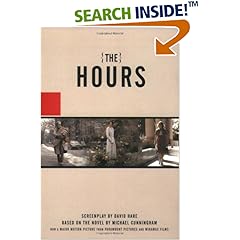
I was supposed to be writing something over the weekend, but couldn't focus, couldn't do anything much. So instead of staring into blank space, picked up my uber-inexpensive copy of David Hare's screenplay of The Hours (Book #5) and started reading that.
I've always been interested in inter-related narratives, multiple stories which crisscross each other through time and space, and this is one of the more interesting ones I've come across recently. I couldn't stand/finish Michael Cunningham's novel, but I've seen the film, and reading the screenplay clarified certain things for me.
Meryl Streep's character is friends with Richard, a poet who's dying of AIDS. Richard was getting this award for his poetry, and Clarissa is throwing a party for him. They have shared this long, arduous friendship, and Richard suspects that he's only staying alive for his friend. Sometime back, Richard had written a novel where there's a character that everyone says is actually Clarissa. Clarissa says it's not her, only that there are too many details which say that it is her. She insists that Richard's work is fiction.
Later, Richard's mother surfaces, when all along I thought she's killed herself--since the mother in the novel killed herself. The mother says that since she abandoned her children, her children probably thought that abandonment was worse than suicide.
All in all, what comes out is that there's this really fine line between fact and fiction, and Clarissa is implicated in Richard's life/work.
Subscribe to:
Posts (Atom)