Tuesday, February 19
The Dangers of Public Fangirling: Fire Away, Fire Away
So I was quietly doing my business in the mall bathroom after a last full show when I suddenly heard a girl's voice singing, "I'm bulletproof, nothing to lose, fire away, fire away."
That other girl probably thought she was alone.
It's not the first time that I've heard that song sung whether consciously or not in public. It's part of the Pitch Perfect fever all over town. In jeepneys, that girl with a backpack and bright pink earphones. On the train, this young woman with the messy bun. I have yet to hear guys hum "Right Round" in public, and it's always "Titanium," so maybe this is a girl thing. I mean, even my fourteen year old cousin sings it inside their shower, and I seriously doubt she even knows what "lady jam"meant.
But that girl in the mall is a different matter.
I choked back the giggle, and I channeled all my energy into composing myself. I was trying to be proper. It was a very thin line between fangirling with a complete stranger and then being a creeper in a public bathroom. On one hand, acting out Beca and Chloe's shower scene could end in a meet cute with another fangirl. Or I could suffer getting arrested or extreme humiliation in the very least. So I hightailed it out of there.
Now I kind of regret not giving in to the moment. When obviously the appropriate response should have been to answer the call and sing back to her and harmonize: "Ricochet, you take your aim. Fire away, fire away. Shoot me down, but I won't fall. I am titanium."
Monday, February 18
Scamming Senior Citizens
I'm putting this out as a Public Service Announcement because we have to protect ourselves and the ones we love.
"Don't talk to strangers" is one of the things we are told as children. Bad things can happen to you. If a conversation is necessary, like meter readers or delivery people, talk to them through the gate. Never ever tell them that you are alone in the house. Don't ever let them into the house.
"Don't talk to strangers" is one of the things we are told as children. Bad things can happen to you. If a conversation is necessary, like meter readers or delivery people, talk to them through the gate. Never ever tell them that you are alone in the house. Don't ever let them into the house.
These days, I think it's also necessary to advise the elder members of the household the same thing. Warn the househelp to never unlock the gates for anyone, even those who claim to be surveyors from an office. Because people with bad intentions are glib and slick and will manage to wangle their way in.
Earlier today, at around lunchtime, They asked if there were senior citizens in the house. The help called out to my aunt, who is seventy, who said yes, there are two of them here. But my mother who just turned sixty was out buying lunch, I was in another part of the yard with ear plugs on, my other cousin had taken her bike out for pizza. The help thought it was okay for my elderly aunt to unlock the gate and let in three strangers. After all, they had very official looking clipboards. She stood by idly texting her friends.
Meanwhile, three people claiming to be survey takers from an Ortigas office were lead to my aunt's upstairs apartment. They asked where "Lolo" was, and she said there is none. She's an old maid. She lives alone. Everyone is out at work or in school. That's when they told her a few magic words: "You won something in a raffle!" Then they told her that she needed to give them some money first before she can claim said winnings. Fortunately enough, my aunt told them that if she had indeed won anything, then couldn't they just substract it off her prize? They didn't get anything from her. By the time that everyone else in the household had returned, the surveyors had left the house. My mother was just dropping by to give my aunt the vacation photos when she learned of the strange visit. "Why did you let them in? You could have been hurt!" That's when my mom roused the entire household.
Why we think this is a scam: First, they didn't even know who to look for. They cast a generic fishing statement: "Are there senior citizens in the house?" Next, they determined relative isolation. There's only a maid and an elderly person. Then they got a solid in, as it was the owner of the house who had opened the gates. It was fortunate that my aunt had locked the gates again. Which somehow prevented them from just running out. Sure, the walls can be climbed, but two women and one gay men can't just climb over the walls unnoticed. Also, telling someone they won a prize and then ask for a "collateral" is right there in the book of scams. If you are gullible enough, you would believe it. But come on. Even the government makes it difficult to claim one's official benefits. You have to bring the actual elderly person to claim money that is rightfully yours. Also, "We are from an office in Ortigas" is vague enough to suggest something is "business-like." Offices would not go around giving out "raffle prizes." Or as my mother put it: "How can you win something if you never bought a ticket?"
We have all received text messages like that, and this is just a door-to-door version of it, casting a wide net for vulnerable people in relative isolation. Targeting senior citizens is just another variation. They are generally nicer people. They make small talk with the couriers and the delivery people. If push comes to shove, it will be easier to beat them in a fight. Or there are always drugs to put down even the strongest, able bodied person.
My aunt tried to downplay the dangers: that she was taller and seemed stronger than the strangers she let in. They seemed official with forms and a checklist that they had her sign. That she didn't give them any money. But they could just as easily drug her, or hammer her to death or--Really, it could have been worse.
Now we are worried that these people would come back, knowing that they had easily been let into the house by an elderly person and the help. They should have known better. That this is clearly a variation of a scam style that's been in the news. We've seen it. We just never thought it would knock on our doors and invite themselves in.
We can never be too vigilant. Tell your children. Tell your beloved elderly relatives. Tell your househelp. Do not talk to strangers. Don't let them into the house. Don't accept candy. Just don't. The doors and gates are locked because the world is a dangerous place, and it is up to ourselves to keep the ones we love safe.
(500) Days of Summer
 |
| The movie in a nutshell. |
I don't know how we came around to talking about heartbreak when we had spent a lot of time discussing zombies and martial arts, but this guy was insisting that (500) Days of Summer was *the* movie to talk about the frailties of modern relationships. Something to do with the rude awakenings between reality and expectation, and I said that's been overly done. Hell, Woody Allen did it better, subtitles and all. Don't care, he said. But that moment at the rooftop party. It's the best movie ever. WTH is this guy talking about?
Surely, it's an exaggeration. But nearly a month later, and I decided to watch (500) Days of Summer again. I've seen it maybe 3 or 4 times, a really long time ago--it's the sort of movie that requires a certain state of mind. The first time I saw it was on the last full show of its first day local screening. I could have seen it weeks or months ahead, but I had avoided other ways of seeing it. It had to be in a theater. The circumstances were different then, but by the time I saw it, I was coming from a meeting that had run a little too late, and one that involved having to down the better part of a beer bucket. Some people wouldn't complain about that kind of job, but well… By the time I managed to haul my half-drunk self from Metrowalk to the nearest mall, the last screening had already started at The Podium. Not wanting to go home defeated, I raced to Megamall, where I promptly bumped into someone I knew who wanted to small talk, and I practically ran away and caught the very last screening just when the disclaimer about everything being a work of fiction were starting to roll. I was alone in my row in a near empty theater, half drunk and heartbroken. "That bitch," the credits said.
 |
| This was how I probably looked like while watching the movie in the theater. |
Of course I loved the movie. I was Tom frakking Hansen and all the Summer Finns of the world could just suck it.
There's nothing original with a story of a boy meets girl, but which the film completely insists is *not* a love story. And there lies the key to appreciating this movie. It's about definitions and denials. If it's not, then how come Joseph Gordon-Levitt is breaking plates on account of a non-relationship that should not matter and the dissolution of which should not hurt one teeny tiny bit? The negation is a confirmation. Not a love story? Hell, yeah, it totally is.
One where the tensions come from the insistence on not defining anything. Humans are strange creatures with a constant need for order and naming things. Perhaps the most dreaded sentence sequence ever in any language: "We have to talk. What exactly are we doing? What am I to you?" Here, there is only one correct answer: an affirmation. "Yes, we are in a relationship. I love you, too." Anything short of it will lead to heartbreak, mayhem and maybe a few broken bones--or muscles. The heart is a muscle, yes? But nobody talks about how a heart is torn like ligaments or hamstrings that can be pulled. It can only be broken in a million pieces, as fragile as glass that met a baseball bat careening from behind the bed of a pickup careening down the bridge at 120mph.
Here is where hindsight and distance are your friends. The first time around, I was as self-absorbed in Tom's plight that I could only see one thing: How dare this Summer person refuse the affection and feelings that I have for her? Everything was going swimmingly well. Tom and Summer hung out in Ikea, making out on the display bed while a Chinese family stared at them from the bathroom. They are perfectly at ease in make believe: the wife makes meatloaf to serve the husband at the end of a workday. Strangely enough, all their faucets do not work. It doesn't matter because they have a second kitchen. For all the perfection of their 50s style domesticity, they are not bothered by the fact that something as basic as the sink not working is going to cause all sorts of problems down the road.
Early in the movie, after that bold insistence that this is not a love story, we were shown a splitscreen montage of Tom and Summer as children growing up. There's this one moment where young Summer, in a yard in Michigan, blows at a dandelion, the petals carried by the wind to the other half of the screen, where young Tom, in New Jersey, tries to catch and burst as many bubbles blown his way. It's the perfect dichotomy: Summer, perhaps making a wish before blowing away the petals, optimistically pinning her heart's desires on petals in the wind; and Tom swatting away at the perfect orbs, obliterating wonder and wishes at the same time. How little did they know that years later, they would be at opposite ends, playing opposite roles in how they approach reality?
I missed this little contrast in world views the first time--it is easy to get lulled by a montage about the leads growing up. It's too early in the movie. Besides, it's just a (very) cute way of showing us how they came to be who they are in the present. But it is important because the imprint has been there all along. We have been told that Tom is prone to misreading cues--he totally misread the ending of The Graduate as romantic optimism. He believed in The One. No matter if his precocious younger sister breaks the myth of compatibility for him: "Just because some cute girl likes the bizarro crap you like, that doesn't make them your soul mate." But no, when Summer hums him back the lyrics to a Smiths song in the elevator, Tom had the realization that, by god, Summer was The One. Not even when Summer herself told him that she's never been in love. "There's no such thing as love," she told him. "It's a fantasy."
 |
| Her name is Summer, not Fate. |
But Tom is sold on the fantasy. Summer was pretty much up front about it. She's young, she wants to have fun. "I'm not looking for anything serious," she tells Tom. "Is that okay?" Tom says yes, he's fine with it. Later it becomes very obvious that he isn't. He wasn't. He will never be the sort of guy who would be fine with Ikea roleplaying with someone who is not his girlfriend, shower sex notwithstanding. And that's the crux of the problem. Tom probably liked Summer so much that he said yes. Even when he said so, what he really wanted was to be boyfriend and girlfriend. Summer herself was clear about it. Later, she would say that "she just knew" that Tom wasn't the one. But as far as Tom was concerned, he was offering his heart and his love on a silver platter. Isn't that what girls want? But Summer is not just any girl.
We're more used to seeing girls acting this way, wanting to know where things are headed before jumping right in. You know that story: the girl sleeps with the boy of her dreams. He's not her boyfriend yet, but she has so many feels about him and her and how good they are together. One day, she would ask him: Just what are we doing? Who am I to you?
Girls are compelled to define the relationship. Girls always want something more, to know where they stand in the order of things. But to be fair, boys do fall in love and make love on Saturday night. Then later ask the girls they're with to DTR* in the middle of pancakes for dinner. At this point Summer realizes that she and Tom are not on the same page. Tom is the boy with all the feels, and Summer does not share them. They break up. It is Day (281) or something like that.
Considering that the movie is called (500) Days of Summer, the break up occurs at (just a little bit to the right of the) story's midpoint. Which also means that Tom spends nearly half the same amount of time to get over the failed (non)relationship with Summer.
Summer wants to be friends, but Tom simply is not equipped to handle that kind of closeness without thinking that she must still be interested in him. She disappears from the greeting card company. Tom also quits his job after it becomes obvious that he can't channel his heartbreak into making grief sound witty and polite enough to put on cardboard. He pursues architecture again, something which Summer convinced him he's actually good at and should pursue instead of rotting in greeting card hell. They have a run in at a colleague's wedding, and Tom becomes convinced he still has a shot at winning her back when she invites him to a party. He goes in with all sorts of expectations that end up dashed when he realizes that the party was to celebrate Summer's engagement. And he was too dense to ever realize it.
Later, he even runs into Summer again at that spot with too many parking lots overlooking the city. He still couldn't believe that Summer was married now to some guy she met in a deli. Where Tom thinks that the universe has forsaken him, Summer believes that Tom has been right all along: that there is someone for her all this time. Someone she wasn't just willing to call boyfriend, but even commit to him as her husband. It just happened that it wasn't Tom.
Surely, this is difficult to accept for Tom: Why not me? Why not let me make you happy? Summer has made herself clear from the very beginning. Tom's sister even tells him that perhaps the relationship wasn't all that perfect in the first place, that's he's only remembering the good things. The warning signs have all been there all along, Tom was only too willing to turn a blind eye so much that the breakup over pancakes came as a surprise. Which shouldn't be, according to Summer, since they've been like Sid and Nancy for months by then. But Tom was oblivious to it.
 |
| Just to be clear: He's Nancy. |
If you think about it, there wouldn't be a problem had Tom been sincere in his reply to Summer, who did not want a relationship in the first place. But Tom wanted to be with her, and perhaps thought that surely, Summer would change her mind. She did, but not in the way he thought she would. And that upset Tom big time. And it was also why I was so upset during all my previous viewings of (500) Days of Summer. I, like Tom, refused to see Summer's line of reasoning.
Distance and repeat viewings bring fresh eyes to a subject. Watching (500) Days now, I could appreciate Summer more. My empathy has shifted away from Tom Hansen and I found myself saying, "How could Tom not see what Summer meant?" People objected then that Zooey Deschanel brought nothing to the table but big, bright eyes and her patent Manic Pixie Dream Girl charm. It wasn't her fault. Summer was meant to be a cipher. She was the obscure object of Tom Hansen's desire because that's all he would let her be. She tried not to be--she was upfront about her intentions, but Tom would have nothing of it. It was necessary for the story. It would be different if we made a movie from her POV. As it is, Summer (and the girl cited in the film's disclaimer) is the fuel to the creative fire. She's meant to be the muse, to stir the imagination. Or as McKenzie, Tom's best friend in the movie said, "The best way to get over girls to turn them into literature." Like Henry Miller did, though that dude slept with a whole lot more of women. Other than that, Summer's affair with Tom was like a pit stop, a minor story arc on the long haul of Summer's "How I Met This Guy Tom Who is Definitely Not Your Father."
Tom's world may have been upended when Summer left, but the loss of faith on love and the universe was only temporary. The dichotomy has been set, reversed and reset to status quo: Young Tom who gleefully burst bubbles became absorbed in his own bubble of romantic fantasies. When those bubbles were burst by Summer, who once believed in wishes, who later became an utter realist, and who dumped him over pancakes. But all would be right again. The key lies in Tom's acceptance on what Summer said: he's pining after the wrong girl. Which implies that there is a "right" one--The One. Something as inevitable as the seasons turning, like Summer turning into Autumn.
_____
*See My So-Called Life. But will credit MTV's Awkward for using the term "DTR" as shorthand for "Defining The Relationship," i.e., "the uncomfortable talk no one wants to have about their dating status."
Monday, February 4
Crazy in Love

People always say that falling in love makes one a little crazy. But what happens when it involves two people with legitimate mental health issues? I'm crazy. You're crazy. Let's be nutcases together. And while the film is no PSA, it does hope that in the end, it gets better.
Silver Linings Playbook has mostly been sold on the media as the romantic comedy dark horse at the Oscars. All four of its lead actors have been nominated for awards. And I loved Katniss Everdeen Jennifer Lawrence. So I thought I would give this movie a shot.
The thing was, the first few minutes were kind of slow going and I was afraid that the movie was going to be this year's The Help, ie, awards hype, lead actress whose work I liked, and yet the movie bored the hell out of me that it was abandoned by the way side. To be fair, it mostly had to do with Bradley Cooper settling in after coming out of an asylum in Baltimore. He apparently beat the shit out of his wife's lover after catching them in the act.
The screen lit up when Jennifer Lawrence's Tiffany was introduced. People usually avoid uncomfortable topics out of politeness and propriety, and this movie's way of telling us that Pat (Cooper) and Tiffany are not "ordinary" is by not letting them have any social filter. Thus, it's okay for Pat to ask Tiffany how her husband died, or how many people she slept with to cope with the loss, or what it's like to sit on a woman's lap. Or for Tiffany to weasel out of Pat the very traumatic incident of walking in on your wife having sex with another man in the shower of very own home, while your wedding song is playing in the background. I totally understand his meltdown.
The scene that sold me on this movie was when they were out in the streets and then Stevie Wonder's "My Cherie Amour" plays and Pat freaks out. Tiffany talks him out of going batshit crazy right then and there. "Are you going to spend the rest of your life scared of that song? It's a song. Not a monster. Come on, breathe. There is no song." Bradley Cooper is mostly hyper in this movie, and I like that Jennifer Lawrence plays it subtle rather than match him with the high octane acting.
It's mostly a by-the-numbers movie. Sure, her Tiffany has issues, but she's still the female character in the romantic comedy who slowly walks the male lead through the path of calmness and sanity--and hopefully, romantic feeling are returned. Tiffany teaches Pat the value of equal trade--I am loathe to say it's unselfishness, because the girl has her own motives--he must do something in return if she's to sneak in a letter to his wife, who has a restraining order against him. I'm not quite sure when Tiffany falls in love with Pat. I'd like to think it's that "There is no song" moment. Otherwise, that moment when she walks out when Pat finally encounters Nikki in the ballroom is just way too late.
Bradley Cooper does have his own subtle moment. I like that scene where he gets a response to his letter to Nikki, who says she might show up at the dance competition. Pat stands outside, reading that (computer printed) letter, and gets a big bright flame of hope that maybe, just maybe, his wife might also still be carrying a torch for him, too.
Random thoughts about this movie:
1. Raising the stakes by participating in a dance competition and then (maybe) fall in love during rehearsals has been done before. My favorite incarnations: Baz Luhrmann's Strictly Ballroom (1992) and the 1996 Japanese movie Shall We Dance?
2. Even then, I want all of Jennifer Lawrence's dance studio outfits. For this leotard obssession, I blame Cassandra July.
3. I want to know what Pat whispered to Nikki. It was an awfully long moment. (In my head, he probably said, You don't deserve me, you cheating female dog.) Thought not that long that Tiffany was still within a block or two of the dance competition venue. But that camera pulling out after the kiss? I cringe.
4. I probably need to watch it again in the future, if I have time. Otherwise, this was just an okay movie and I don't get all the hype. For all I care, Pat could have been played by Gerard Butler--the role is certainly his territory. But the movie won't be as incandescent without Jennifer Lawrence. She makes it liveable--especially for a movie that is clearly following Bradley Cooper's point of view. I certainly will understand if she wins. I probably won't be as forgiving if Anne "One take, bitches!" Hathaway wins.
Saturday, January 26
Adventures in Jodie Fostering, Part 2: The Silence of the Lambs

I have a confession to make: I have never watched the full movie before. I had been too young to see it in the theaters. I've seen bits and pieces on television, but could never stay with it long enough because Anthony Hopkins' Hannibal Lecter scared the bejeezus out of me.
Then there's the part that's been shown over and over in film and writing classes since then: Clarice Starling pacing outside Hannibal Lecter's cell, unease written all over her, the prisoner stands calmly. It's a role reversal that leads us to the real reason why Agent Starling is intent on capturing Buffalo Bill. It's more than proving herself worthy and better than the men in her world or saving the senator's daughter. All Clarice wants is a good night's sleep. For the lambs to stop crying.
When I finished the movie, aside from being scared sh*tless, my first thought was: Godammit, I should have watched this sooner.
Hannibal Lecter is a master at perceiving characters. Starling has not even graduated yet from the FBI training camp, but she's at the top of her class and is given this special assignment to talk to Lecter. She's been warned never to tell him anything personal. Yet all it takes is a single eye to toe look ("Your good bag and cheap shoes."), a couple of seemingly innocent questions (Undergrad at the University of Virginia) and he has Starling's number.

The movie is more than two decades old, came out three years before The X-Files and Dana Scully, at least 6 years before David Fincher's Se7en and a good ten years before CSI numbed us to the specifics of forensic investigations. (Odds are ten to one that Gil Grissom's insect geekiness owes a lot to the insect geeks in this movie. Anyway...) It's not really the grizzly details, the blood and gore and even the microscopic DNA whatever that matters. It's how the mind works, the wheels turning and memories unlocking. And yet, The Silence of the Lambs is still arguably better at providing psychological insight as to why serial killers/criminals do the things that they do.
The most interesting parts of The Silence of the Lambs isn't the gore, it's the trust slowly building between Lecter and Starling, the quid pro quo, and that slow dread of waiting whether Lecter, who has developed a mild obsession for his student, would hunt her down and have a new friend over for dinner. And when Starling descends into that basement and the lights go out, you think back to that early scene during FBI bootcamp, that fake raid that ends with Starling with a gun on her head. It's not just a blind spot, it's a goddamn blackout, and dammit if Buffalo Bill gets to her first.
But what I like the most about Jodie Foster's Agent Starling is that she gets the right mix of vulnerability and courage. She *is* better than everyone in class. And as Amy Taubin points out in her essay in the Criterion Collection: "Clarice's mission is not to marry the prince but to rescue the maiden." Whether by smarts ("Your anagrams are showing.") or with the aid of a gun, Agent Starling gets things done.
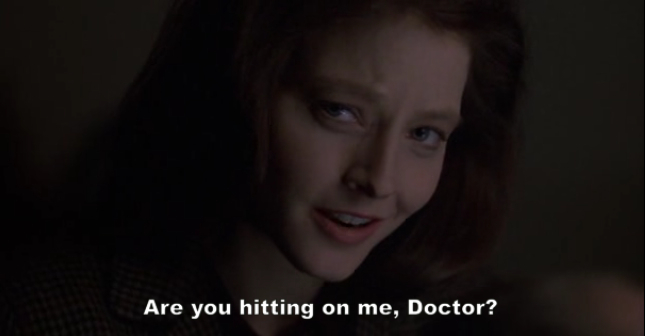
You breathe a small sigh of relief when it's over. And yet it's not really over. Lecter is still out there, having dinner with an old friend and phones his new one during FBI graduation. Lecter has one question: Have the lambs stopped crying? Perhaps the more apt question is this: Will it ever stop?
The Silence of the Lambs has quite the afterlife: There are many attempts to clone the movie's success and parlay it into television. (The movies are another matter.) There is a spinoff under development, a crime procedure that follows Starling after she graduates from the FBI academy. There's also a prequel that follows Lecter in his early days as a psychiatrist who occasionally eats his patients and the police. Or as the AV Club jokes, to complete this cottage industry mindset, all we need is a show that comes from Buffalo Bill's dog's point of view.
Tuesday, January 22
Adventures in Jodie Fostering: Panic Room

I have been thinking a lot about Panic Room and Zodiac, so this has more to do with David Fincher, and less to do with Jodie Foster. Although I might admit that the "I am single" speech at the Golden Globes gave the viewing that extra push.
I had first seen Panic Room in a theater it in its first run in 2002, and I'm glad to say that it does hold up to scrutiny and remains terribly scary even when watching on a smaller screen. Perhaps the more contained dimension helps in cramping up the space even more than the 6x14 feet of the titular safe room.
All we need to know happens in the first few minutes: a recently divorced mother checks out new dwellings with her young daughter. On their first night, three burglars break in looking for the millions allegedly stashed in the safe room. The contained location becomes the crucible for all the action. Everything happens in one night, in that house, and mostly inside and the immediate environs of the panic room.
What's interesting to watch in Panic Room is how David Fincher and the script by David Koepp were able to negotiate the balances of power between the intruders and the homeowners, managing it mostly by who is inside or outside that three feet thick steel door, and then having it escalate to matters of life and death.
I also love it that the entire movie is summed up in a couple of exchanges. The first one was when Meg realized there were other people in the house and makes a run for her daughter's room. "What's happening?" The barely awake Sarah asks while they race to the panic room. "Pinball, in a house," Meg says. Which is true. A core of five (or six, or eight) people bouncing around the house, trying to force each other to open or slam doors.
Then there's conversation waged over the security camera monitors. Jared Leto's Junior holds up a series of handwritten signs to tell Meg what their intentions are: "What we want is in that room." Junior figures out that women crave security, so he adds: "We will let you go." Even young Sarah knows this was a total lie, so she tells her mother to tell the invaders off. "We're not coming out. We're not letting you in." It's still not tough enough for Sarah so she tells Meg, "Say 'fuck'." Meg swears, but in the right way, so she has to repeat it for emphasis. "Get the fuck out of my house." That is the entire movie in a nutshell: Shit is going to go down if they don't do as she says.
Also interesting for me this time around is the relationship between Jodie Foster's divorcee mother and daughter, a really young Kristen Stewart, several lifetimes before she became Bella Swan or became known as KStew. Hell, the first time around, I didn't even know Kristen Stewart was the kid in the picture. Her Sarah is pretty much a tomboy, with her androgynous haircut and even advising her mother to swear to let the burglars know she means business. Yet, Sarah is pretty much the vulnerable child, spurring her mother to abandon the safety of the panic room so she could get her child's medication.
Then I read elsewhere that Nicole Kidman was originally cast to play the mother, and Stewart was cast to play off her: the daughter as antithesis to the helpless, glamourous mother. But Kidman had a knee injury from Moulin Rouge and had to leave. When Foster came on board, the role of Meg was rewritten to make her tougher, and more similar to her daughter. What even complicated the shoot more was that Foster found out she was pregnant five weeks into the shooting. But I have to say there is sheer joy in watching mother and daughter interact.
Although some people might say that the story is pretty thin, I think it just can't get any tighter than that. I would even venture to say that Panic Room is way better than similar movies during its time (Phonebooth with Colin Farrell comes to mind) or even later--I'm thinking of Liam Neeson's Taken movies, but that "Harm my family and I swear to hell you'll pay for it" revenge theme comparison might be better suited to later Jodie Foster movies like Flightplan and The Brave One, which I totally intend to watch because it promises to be sheer good fun. I have a feeling that Jodie Foster makes for a better action star than Tom Cruise or even Angelina Jolie. We'll see.
Wednesday, July 4
Revenge


Got caught up in Revenge all day yesterday.
The show's plot is as old as time: a young woman returns to a town to avenge all the wrongs done to her and her family. She's not who she claims to be, but then again, so is everyone--they all have secrets that can lead to their downfall.
What I love about the show knows their story has been done before, and yet it keeps you glued to the edge of your seat until 1AM on a rainy night. But most of all, the show winks at you--like that camera secretly wedged in between the books, situated right above Dumas' The Count of Monte Cristo, a book that I loved and devoured as a kid along with all the Brontes and Dickens.
We are astounded and shake our heads now that people can't seem to recognize people they know from way back. Something horrible happens, people disappear for years and then years later, a stranger comes to town fabulously wealthy and well-coiffed and no one recognizes them until it's too late.
A revenge plot is a revenge plot. Soap opera on television uses that. Thalia straightened her curly, barrio-lass hair and the innocent Marimar becomes the cunning Bella. And everyone tells her, "Hey, you remind me of someone I once knew." Even television that claims to have the scope and literariness of the novel, i.e. Mad Men, uses that secret identity/switched identities plot. It was good for literature then, it was good for television now. Hell, even Jose Rizal couldn't help himself. Seriously, did no one tell Crisostomo Ibarra/Simoun, "We knew it was you all along. Now can you please shave that terrible goatee."
Wednesday, June 20
The Rom-Com Template
Vulture's Kyle Buchanan cracks down on the romantic comedy template--well, a very particular subset of the genre-- the latest incarnation of which is the Keira Knightley-Steve Carrell starrer Seeking a Friend for the End of the World.
Briefly, the formula seems to be this:
Briefly, the formula seems to be this:
Sad-Sack Comedian + Manic Pixie Dream Girl + Wordy Title = Rom-Com Template.They plugged in the formula using several variables, and what do you know, it does fit. My favorite of those name-checked is Eternal Sunshine of the Spotless Mind, but I can also live with (500) Days of Summer (with queen of the Manic Pixie Dream Girls Zooey Deschanel) and Lost in Translation (directed by queen of the Manic Pixie Dream Director Sophia Coppola). Bill Murray wins for the largest age discrepancy from love interest--34 years between him and Scarlett Johansson.
Monday, June 4
A Pratfall is better than anything.
Preston Sturges, father of the screwball comedy, drew up the following rules for box office appeal:
- A pretty girl is better than an ugly one.
- A leg is better than an arm.
- A bedroom is better than a living room.
- An arrival is better than a departure.
- A birth is better than a death.
- A chase is better than a chat.
- A dog is better than a landscape.
- A kitten is better than a dog.
- A baby is better than a kitten.
- A kiss is better than a baby.
- A pratfall is better than anything.
Sunday, June 3
The Fairest in the Land
 |
| Tell me I'm the fairest in the land, or I shall impale you with my crown. |
I saw Snow White and the Huntsman on opening day. I was there partly to see Kristen Stewart grimace her way through the movie and partly to watch Charlize Theron's milk bath dry. Also, I have a standing bet that KStew will have more chemistry with Theron's Queen Ravenna than with the Chris Hemsworth's Huntsman. Or any other guy they throw her way for that matter. There's even a meme dedicated to that, but that's another matter.
I was also curious how the movie would pull off this premise: If Charlize Theron is your Queen, how can the mirror declare KStew the fairest in the land? Anyone with eyes and a cursory glancing knowledge of the tale knows the story didn't say "most awkward and would be first in line at the Converse sale." Sure, sure, Snow White is but a bud versus the Queen's beauty in full bloom, and the princess can still blossom into a fair maiden later in her youth. But, KStew is the fairest in the land, really? The One who represents "life itself" is deader than anything or even The Nothing. If I were the Queen, I'd throw a tantrum, too. But while wearing fabulous clothes made of raven feathers and hate, of course.
The most interesting dynamic in the movie is still that of the Evil Queen and her stepdaughter. We see how she took over Snow White's father's kingdom: She sends out a phantom army, plays a damsel in distress, which of course pumps up the need to protect said damsel and marry her immediately, like the very next day.
There are a lot of questions surrounding Ravenna's rise to power: how come this king has not heard of this modus before? Is beauty really so powerful that it enamors and enslaves men and drives them to their own ruin? We'll accept that this beauty is potent, courtesy of the spell cast by Ravenna's mother. It is unclear how often this spell be fed with the beauty of young women. There was this lone young woman in the tower with Snow White in the beginning--the one that Snow White wanted to liberate later on only to discover that the young woman had been drained of her youth. But later on, there's this hall full of dead women. Does Queen Ravenna have a cheat day where she can gorge on a buffet of pretty damsels?
Also, the Mirror doesn't seem to do much other than to point out that the spell can be undone by the fairest in the land, and so Snow White must be vanquished. Once Ravenna became weak, there is no solace or advice from the Mirror. But it does drive Queen Ravenna to use all her powers. She apparently has the ability to transform herself--and guess what, she chooses to be the Duke's son William, Snow White's childhood protector.
 |
| Trolled! |
So technically, Snow White's first kiss is with her stepmother. And it kills her. What can be more awkward than that? To be fair, Snow White does get two more kisses: once from William--the kiss we have been told should revive her. But it did not do anything. It is the Huntsman's kiss that brings her back to life. Strangely enough, this turn of events wasn't explored much in the movie.
I was under the impression that this would be about empowering fairy tale princesses, i.e., Snow White the Warrior Princess. The trailers were all about Snow White in chainmail on a galloping horse, on her way to battle the Evil Queen Stepmother, aptly named Ravenna. (How very Mulawin of them, no?) Unless the princess had received warrior training prior to her imprisonment in the north tower after her father's death, then Snow White has to get her warrior training somewhere before going off into a great battle, yes? So perhaps that's where the Huntsman goes in. I thought the deviation from the fairy tale would come once Princess and Huntsman get together. The movie is named Snow White and the Huntsman after all.
But the closest we get to hunting lessons from the Huntsman is that one moment where he tells Snow White that she should drive the knife in all the way to the hilt. Where is the Karate Kid training montage? Where is Snow White's initial rejection of her role as savior? Other than that, it's a movie that's partly the Fellowship of the Dwarves in Pandora with a side of Narnia. And that's it, off to battle we go.
Seriously, who rides off to battle after a semi-awkward speech from a recently back from the dead princess?
There is this bit in the end that "fairest in the land" does not pertain to beauty but a sense of equal judgment. So it really is about Snow White reasserting her rightful role as ruler of her father's kingdom. She has no need for the Huntsman or the Duke's son. But I am more concerned about the Queen's fate: What does it mean when a woman is driven to protect her daughter by casting a spell that allows her to rise to power so that she would not suffer at the hands of men again, but the spell forces said daughter to make other women suffer at her expense, to feed off their youth and beauty? And yet her ultimate undoing comes from the one girl who refused to give her her heart. All it takes is three drops of blood.
(Here's an alternative take on this: Who are we kidding? I went into the theater to gawk at the screen. The movie is gorgeous to look at, Charlize Theron is really pretty and wears fabulous clothes made of raven feathers and hate. Here's the interview with Snow White and the Huntsman costume designer Coleen Atwood on how hundreds of roosters sacrificed their lives at the altar of Queen Ravenna.)
Subscribe to:
Posts (Atom)