The scholar Michael Wood investigates the mysterious testicles of Henry James. Several generations of writers have speculated on whether the lack of relations with girls was a sign that the author of Portrait of a Lady is actually a lady a-hiding in a closet. This curiosity made writers like Ernest Hemingway and F. Scott Fitzgerald include this literary rumor in their works.
Wood then points out that this curiosity on the part of the authors Hemingway and Fitzgerald may have been a reflection that they were gay lovers. Wood cites the end of chapter 2 of The Great Gatsby which somehow suggests that Nick Carraway had a thing for Mr. McKee.
Everyone's talking of cowboys so much I might resort to riding camels. Nyar. But before I self-impose a gag order on talking about cowboys and camels, here is the really hilarious Brokeback shopping list from the summer of '62.
Friday, February 24
Freaky McDonald's Commercials
Tim Harrod of Stay Free! Magazine takes a look at the really freaky universe of McDonald’s commercials. Links to videos of the original ads also feature a pre-lobotomy Evil Grimace.

We live in a really perverse world where happiness is measured by the prices of Big Macs and the availability of Coca-Cola, the world's second most recognizable word. Look at how we turned out. Part of me thinks that this is so because we still have not solved the age old question of "So what is Grimace really made of?" No wonder everyone is going bonkers.
We live in a really perverse world where happiness is measured by the prices of Big Macs and the availability of Coca-Cola, the world's second most recognizable word. Look at how we turned out. Part of me thinks that this is so because we still have not solved the age old question of "So what is Grimace really made of?" No wonder everyone is going bonkers.
Thursday, February 23
The Sign
I should have considered this as a hint of things to come:

The Sign
Originally uploaded by xkg.
The Sign
Originally uploaded by xkg.
But no. I insisted on getting out of bed and out of the house. And so--
(1) Got nearly pelted by tomatoes. Post-it to self: Should check handouts before distributing them to see if all the pages are there.
(2) I learned that you can't count on student politicians to know their battle signs anymore. So you traded in your Chuck Taylors for Nine Wests and you're pretending to be an activist? That wasn't a very good move. Also, if you can't do Six Degrees of Neruda to Madonna, you will not receive a vote from anyone in this class.
(3) Maybe it's time to own it: I am no novelist. Even if I can connect Neruda to Madonna in three.
Sunday, February 19
Thursday at the Fair
Accidentally found myself at the fair last Thursday. I was going straight home after class, but my classmates went so I tagged along. I didn’t even know which bands were playing until Guerrero and I were at the gates. After I saw Kitchie Nadal’s name in the lineup, I jokingly said that my mission that night was to heckle her if ever she played her Eraserheads cover. Little did I know that heckling was going to be the order of the night.
There still weren’t that many people at 8pm, but Kjwan gathered a bigger crowd near the stage. After a few songs, another band started setting up onstage. While doing mic tests, this guy displayed an amazing familiarity with cuss words and basically started shooting down UP. “All the poor people out there have nothing to eat, but here we are, enjoying ourselves at the fair.” Some other guy sat there onstage, ate his meal from a Kenny Rogers box. Badmouth Guy then started hurling food at the crowd. The crowd booed back at them.
We don’t know whether they were booted out or his diatribe was already done and they got off the stage. A buzz started among the people at the fair: Who the hell was that guy and why was he ruining our night?
The hosts, a couple of cutesy sorority girls, went back on the stage and did the weirdest thing: they apologized for the band, that they didn’t know the guys would do such a thing, etc. I don’t know which was worse: the shock of being insulted by some guy from the school down the road or for the organizers to make such a big fuss over it. Some people tried to find a trace of humor in the bashing, others argued that there shouldn’t even be a slight confusion about what happened—it was just plain bad manners.
Most of the bands who went onstage after The Brockas, whose website bills it as 'unquestionably the best and most important band in rock history', appealed to the crowd’s sense of tribe loyalty. Kiko Machine worked the crowd with their Unibersidad chant and Sugarfree did a few stanzas of UP Naming Mahal.
By the time Kitchie Nadal finally played after two thousand years of setting up—it must have been equipment trouble since she sang a few octaves higher than the rest—the crowd had sort of forgotten about the incident. They pressed forward, but they were just quietly standing and listening. At one point she even asked the crowd to get in the groove of things—they were too much in a daze. Even when she finally sang about not being a maniac like the others, I didn’t even want to heckle anymore. Cel and I just walked back to our spot on the grass, sat back and shrugged.
Then Gwen showed up and we joined the crowd when Barbie Almalbis belted out this cover of “High,” then “Just a Smile.” In fairness, the girl knew how to work the crowd. People regained their enthusiasm: they started bobbing their heads to the music, waving their hands, singing along. She announced that her first solo album was coming out in a couple of weeks. When she played her last song, the crowd was reluctant to let her go.
Something always happens at the fair. When Tamadita attended the fair in our freshman year, somebody got stabbed and the attacker ran right in front of them. This year, a boy got ran over by a really huge vehicle and died.
As for me, my last clear memory of a UP fair was some years back, when a rather hefty girl was finding it difficult to climb up one of those PowerUp walls. She was rather determined, but then Radioactive Sago came on with “Ayoko ng Baboy.” The crowd spotted the hefty girl on the wall, with her confusion of ropes, and alternately cheered and jeered her. The band thought it was for them and sang with even more enthusiasm. I remember thinking that at that very moment, I was so glad I wasn’t that girl on the wall.
There still weren’t that many people at 8pm, but Kjwan gathered a bigger crowd near the stage. After a few songs, another band started setting up onstage. While doing mic tests, this guy displayed an amazing familiarity with cuss words and basically started shooting down UP. “All the poor people out there have nothing to eat, but here we are, enjoying ourselves at the fair.” Some other guy sat there onstage, ate his meal from a Kenny Rogers box. Badmouth Guy then started hurling food at the crowd. The crowd booed back at them.
We don’t know whether they were booted out or his diatribe was already done and they got off the stage. A buzz started among the people at the fair: Who the hell was that guy and why was he ruining our night?
The hosts, a couple of cutesy sorority girls, went back on the stage and did the weirdest thing: they apologized for the band, that they didn’t know the guys would do such a thing, etc. I don’t know which was worse: the shock of being insulted by some guy from the school down the road or for the organizers to make such a big fuss over it. Some people tried to find a trace of humor in the bashing, others argued that there shouldn’t even be a slight confusion about what happened—it was just plain bad manners.
Most of the bands who went onstage after The Brockas, whose website bills it as 'unquestionably the best and most important band in rock history', appealed to the crowd’s sense of tribe loyalty. Kiko Machine worked the crowd with their Unibersidad chant and Sugarfree did a few stanzas of UP Naming Mahal.
By the time Kitchie Nadal finally played after two thousand years of setting up—it must have been equipment trouble since she sang a few octaves higher than the rest—the crowd had sort of forgotten about the incident. They pressed forward, but they were just quietly standing and listening. At one point she even asked the crowd to get in the groove of things—they were too much in a daze. Even when she finally sang about not being a maniac like the others, I didn’t even want to heckle anymore. Cel and I just walked back to our spot on the grass, sat back and shrugged.
Then Gwen showed up and we joined the crowd when Barbie Almalbis belted out this cover of “High,” then “Just a Smile.” In fairness, the girl knew how to work the crowd. People regained their enthusiasm: they started bobbing their heads to the music, waving their hands, singing along. She announced that her first solo album was coming out in a couple of weeks. When she played her last song, the crowd was reluctant to let her go.
Something always happens at the fair. When Tamadita attended the fair in our freshman year, somebody got stabbed and the attacker ran right in front of them. This year, a boy got ran over by a really huge vehicle and died.
As for me, my last clear memory of a UP fair was some years back, when a rather hefty girl was finding it difficult to climb up one of those PowerUp walls. She was rather determined, but then Radioactive Sago came on with “Ayoko ng Baboy.” The crowd spotted the hefty girl on the wall, with her confusion of ropes, and alternately cheered and jeered her. The band thought it was for them and sang with even more enthusiasm. I remember thinking that at that very moment, I was so glad I wasn’t that girl on the wall.
Monday, February 6
Paolo Matalo
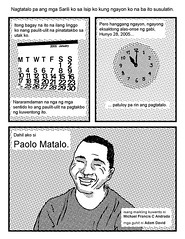
paolo matalo // page 01
Originally uploaded by nut mustard.
Here are some frames from the forthcoming comic book version of "Paolo Matalo," a story included in the collection "Apartment sa Dapitan" by the very controversial Mykel Andrada.
Sunday, February 5
Eleanor Rigby

I’ve always found Douglas Coupland’s works as somewhat antiseptic. Generation X was a “tale for an accelerated culture” and everyone was searching for meaning in their McJobs, nobody really cared for personal hygiene and wore clothes for days on end--oh wait, that was Keannu Reeves in his grunge phase. In Life After God, people went for really long drives and then why they did that was sort of lost on me after. They read like proofs to a theorem: mainly, that life was meaningless and we live in an absurd universe; but well, is it bad to hope for a little meaning even for a few precious seconds?
Reading Eleanor Rigby right after Bergdorf Blondes is like jumping into a cold shower after a long hot soak in the tub. Right on the verge of falling asleep, Coupland wakes you up. But not in the way that Chuck Palahniuk wakes you up with a punch in the gut. Liz Dunn could have been Bridget Jones. She’s thirty-seven when we first meet her, overweight, works a dead end job, with a really bland condo. She’s “never been married, righthanded and [her] hair is deep red and willfully curly.” When we first meet her, she’s out there in the parking lot of a video store, with stacks of Bambi, Terms of Endearment, How Green Was My Valley in her arms. She’s going to get her wisdom teeth extracted and she doesn’t have anyone to even drive her to the dentist’s. Then she sees the Hale-Bopp comet. Right in the middle of her marathon, she gets a phone call: a young man was admitted into the hospital and her name and number was inscribed in the medical alert bracelet. Had Helen Fielding written this book, that young man would have been the love of her life and would change her forever. In a skewed way he was and he did, but in a completely unexpected way.
Eleanor Rigby is the first Coupland book that actually makes you want to care for the protagonist. She’s confessed that she’s been lonely all her life, in the way that solitude can make you want bash your head against the walls of your really clean and bland condo. You really want her to be happy and there’s a vague suggestion that maybe she would be. In Coupland’s world, the universe gifts you with your own special meteorite, and then later it’ll get you arrested in an airport. So you can never really be too sure your meteorite is nothing but a ticking bomb. With Coupland, you can never be too sure.
Many thanks for Bluekessa for lending me the book.
Brazilians and Bergdorf Blondes
The bright blue green cover of Bergdorf Blondes entices the reader to plunge into the world of Park Avenue princesses, where a Brazilian is considered the mark of sophistication (and "going to Rio" is something girls should live for), and flying in a private jet for a weekend jaunt in the French Riviera is the way to go. But the protagonist of this novel is not a blonde herself. She has to work to support her addiction to Chloe jeans. But ‘careers,’ as far as princesses go, are but amusing distractions while you go about trying to get engaged to men with their own brown signs and jealous wives.
It has all the symptoms of chicklit. But all told, Bergdorf Blondes is a very fast, very light read—I finished it in one night. I’m not sure though if I’ll dive into that corner of the bookshelf often. I’m not inclined to read the Shopaholic books, and I really cannot be bothered to join the waiting lists for Birkin bags, nor am I likely to spend 60k for an LV purse. I’m likely to pick up the habit of exfoliating twice a week or reading the product packages to see whether ‘alcohol denat’ is high up in the ingredients list, but that’s it for me.
Saturday, February 4
Grownup Girls and Teen TV
Nerve's Kara Jesella delves into the odd phenomenon of grown women who watch teen tv. In a survey from Business Week, it was revealed that shows such as The OC, Smallville and Laguna Beach, while being marketed to the thirteen-to-thirty-four bracket, maintains an average viewer age of thirty-seven. What the magazine article did not say, and which the writer inferred mostly from anecdotal evidence, was that this "age-inappropriate audience is mostly female, urban, smart, creative, professional."
Here is an entire generation of females who obssess about adolescence. Jessela explains that it's partly because partly because "they saw their high school selves in the awkward, sensitive, precocious Molly Ringwalds and Claire Danes and Mary Stuart Mastersons." These are young women who knew early on that they're going to do fab as adults, girls who couldn't wait to escape the "tyranny of proms and pimples."
But I'm more inclined to think that the phenomenon of grown girls stocking up on the complete Buffy DVDs, quoting John Hughes and crushing on Seth Cohen has less to do with the "nostalgia of reliving the good old days." It's more of a delayed reaction, of finally dealing with the trauma of young adulthood when it's now just a mirage, something irretrievable and can only be relived on Thursday nights and DVDs on slow weekends.
Now please excuse me while I tune in to my weekend fix of The OC.
Here is an entire generation of females who obssess about adolescence. Jessela explains that it's partly because partly because "they saw their high school selves in the awkward, sensitive, precocious Molly Ringwalds and Claire Danes and Mary Stuart Mastersons." These are young women who knew early on that they're going to do fab as adults, girls who couldn't wait to escape the "tyranny of proms and pimples."
Are we masochists, intent on punishing ourselves for our present successes? Were our own adolescent emotions so complex that it's comforting to see them simplified, soap-opera-style? Do we all have some deep primal longing to be skinny and pretty and have all of the boys like us?And yet when they're finally out there, in the real world, they tune in and watch young actresses the equivalent of the popular girls in their own high schools. One explanation that the author offers is that these young women have absorbed a camp aesthetic from their gay friends, who probably weren't really out in high school, and watching teen shows allows the castaways, the losers, the nerdy girls and effem boys to reimagine life with themselves in all the best roles.
But I'm more inclined to think that the phenomenon of grown girls stocking up on the complete Buffy DVDs, quoting John Hughes and crushing on Seth Cohen has less to do with the "nostalgia of reliving the good old days." It's more of a delayed reaction, of finally dealing with the trauma of young adulthood when it's now just a mirage, something irretrievable and can only be relived on Thursday nights and DVDs on slow weekends.
Now please excuse me while I tune in to my weekend fix of The OC.
Thursday, February 2
What to do with all that junk if you're not Fergie
The lyrics to the Black Eyed Peas' "My Humps" may sound inane, but the song is seriously one of the more infectious earworms from last year.
So to get it out of your head, Lucas Cox gives us alternative answers to that Black Eyed Peas query about what to do with all that junk, all that junk inside that trunk.
So to get it out of your head, Lucas Cox gives us alternative answers to that Black Eyed Peas query about what to do with all that junk, all that junk inside that trunk.
Wednesday, February 1
Vengeance is not ours
Does this sound familiar to you:
"Alms, alms, spare me a piece of bread. Spare me your mercy! I am a child, so young, so thin, so ragged."
I don't know about you, but when I was in grade school declamation contests were all the rage. (Singing contests were in, too. Boys and girls regularly unleashed their inner divas--just try Whitney Houston's "One Moment in Time," why don't you?) Whitman's "O Captain, My Captain!" and Henley's "Invictus" ("I am the master of my fate/I am the captain of my soul") were popular choices. Girls would be prevailed upon to do their version of Sisa from Noli Me Tangere. (Basilio! Crispin!)
But the weirdest piece to ever hit the Philippine declamation scene was something that spoke of the horrors of the Japanese Occupation in the Philippines. I was eleven when I was forced to perform this piece myself. It's only now that it became evident that it was meant for a boy, "Oscar." The possibilities are mind-boggling. So all along, this was about a male ana? Gasp! But maybe back then they changed the persona into whatever convenient configuration they needed at the moment.
High school was a different matter. In freshman year, our speech and language teacher decided that we should all acquire a British accent. We rolled and/or dropped our R's upon request and asked each other how we wanted our tea. He was also our music teacher and we had to sing "A Mighty Fortress Is Our God" back to back with "I Can't Cry Hard Enough." We were in a state university and a bunch of us were there precisely because we were refugees from Catholic schools. You can imagine that this caused a great confusion among us. I think we are all still traumatized. Maybe even more so if our teacher had his way about teaching us how to speak German, but I digress.
A while back, my aunt asked me to look for a declamation piece for my cousin, and I couldn't think of anything but this. So why not perpetuate this piece, no? Just because "to forgive is divine, but vengeance is sweeter." Hehe. It would be interesting to watch an entire generation of kids crawl all over the stage in an attempt to give this piece "justice."
So if you want to relive your childhood, get the full text here.
"Alms, alms, spare me a piece of bread. Spare me your mercy! I am a child, so young, so thin, so ragged."
I don't know about you, but when I was in grade school declamation contests were all the rage. (Singing contests were in, too. Boys and girls regularly unleashed their inner divas--just try Whitney Houston's "One Moment in Time," why don't you?) Whitman's "O Captain, My Captain!" and Henley's "Invictus" ("I am the master of my fate/I am the captain of my soul") were popular choices. Girls would be prevailed upon to do their version of Sisa from Noli Me Tangere. (Basilio! Crispin!)
But the weirdest piece to ever hit the Philippine declamation scene was something that spoke of the horrors of the Japanese Occupation in the Philippines. I was eleven when I was forced to perform this piece myself. It's only now that it became evident that it was meant for a boy, "Oscar." The possibilities are mind-boggling. So all along, this was about a male ana? Gasp! But maybe back then they changed the persona into whatever convenient configuration they needed at the moment.
High school was a different matter. In freshman year, our speech and language teacher decided that we should all acquire a British accent. We rolled and/or dropped our R's upon request and asked each other how we wanted our tea. He was also our music teacher and we had to sing "A Mighty Fortress Is Our God" back to back with "I Can't Cry Hard Enough." We were in a state university and a bunch of us were there precisely because we were refugees from Catholic schools. You can imagine that this caused a great confusion among us. I think we are all still traumatized. Maybe even more so if our teacher had his way about teaching us how to speak German, but I digress.
A while back, my aunt asked me to look for a declamation piece for my cousin, and I couldn't think of anything but this. So why not perpetuate this piece, no? Just because "to forgive is divine, but vengeance is sweeter." Hehe. It would be interesting to watch an entire generation of kids crawl all over the stage in an attempt to give this piece "justice."
So if you want to relive your childhood, get the full text here.
Subscribe to:
Posts (Atom)