These days, it seems to me that everywhere you look (around the web, at least), people are talking about Scandinavian crime novels. In his Slate essay, Nathaniel Rich claims that the most peaceful people on earth write the greatest homicide thrillers. He offers a few reasons why the genre flourishes in the region: "The crime novel, and particularly the British crime novel, has been enormously popular in Scandinavia for decades. And the famous Nordic pragmatism is well-suited to the intricate mechanics of crime investigation plots. But the best explanation is the most mundane: Crime novels sell." Rich proceeds to list down the writers who started their careers in a more literary vein, but eventually, the poets, playwrights, novelists and translators found a bigger audience--and a bigger paycheck--in writing about crime.
If crime novels sell and the writers profit from it, there must surely be a very good reason why readers like it as well. For this, Rich points out that the allure of the Scandinavian crime novel from others is "not some element of Nordic grimness but their evocation of an almost sublime tranquility. When a crime occurs, it is shocking exactly because it disrupts a world that, at least to an American reader, seems utopian in its peacefulness, happiness, and orderliness." There something a little bit troublesome about Rich's assertion. Rich fetishizes the blood on snow image as something close to the divine.
On the other hand, Larisa Kyzer of The L Magazine looks deeper into Rich's assertion that Scandinavians write the best crime novels. Kyzer believes that there is more to it than just the inherent creepiness--or even exoticism--of having blood spreading against pristine white snow. The narrative concerns of the Scandinavian crime novel do not stray too far away from those of the established literary tradition. It still finds its roots in the police procedurals and detective stories. However, "more often than not, the gruesome goings-on in Scandinavian crime novels have their root in everyday societal tensions and shortcomings: racial/ethnic/religious prejudices, the marginalization of 'outsiders,' governmental corruption, unacknowledged domestic abuse."
The Nordic countries are peaceful because of homogeneity. If everyone is like everyone else, then it would be too hard to disagree with the public sentiment. But because each of these countries started seeing more faces different from their own in the last several decades, change started to seep in. And according to Kyzer, "more often than not, [it] created quite an existential crisis for societies which have for so long been able to claim a fundamental sameness in traditions, language, and cultural outlook." They cannot sustain their unofficial motto, "Be like everyone else. Thus, this disturbance is articulated in their fiction: the rise of neo-Nazi gangs, Swedish townspeople getting all antsy because of their Sami neighbors, arson in refugee camps, shutting down child prostitution rings.
The writers of crime fiction are holding up a mirror to the welfare states' shortcomings. If so, then the uniqueness of the genre comes from its "unflinchingly honest stock of its failures. So often, these are novels of conscience and reflection. Novels which, in their own small way, take responsibility for a social system which makes earnest promises of inclusion and protection, but continues to fail so many of its constituents."
The curious question is this: the Scandinavian countries have a social system that works, the citizens are among the world's happiest even if they perceive their governments can do better. The low crime rate pushes the writers to imagine "tawdry crimes." On the other hand, the Philippines has a government that cannot be trusted to deliver even the basic services, most of the population live in dire poverty and yet steadily confesses that they are a "happy" people, and crime is so prevalent that you only have to step out of your house and see it happen to someone you know, perhaps committed by someone you know. We have seen all manners of killing people--the usual ice pick stabbing, boys playing basketball and on the way home they get riddled with bullets, a woman's body chopped into pieces, left to be discovered in several plastic bags, or a man killed and body sealed in a drum filled with cement and dropped into the river. Sometimes there is a desperation to the crime: I am thinking of that mother who cannot afford to feed her children, and so takes them in a Jollibee in the mall and then poisons them all.
Scandinavian crime fiction functions as a critique of a society that has its ills, is only starting to feel the disturbance of having a varied society. It also offers a way of escape, a different reality from their "we're all the same, modular Ikea" existence. But crime fiction is also a very straight forward kind of narrative: here is a body, thereafter lies a solution as to who did this and in what manner. Problem, solution. All is right in the world.
However, if crime is all around you, so desperate and gruesome that you want it to be something that you merely imagined, is it even possible that you would want to write about it? Of what use is fiction then for our collective imagination? Does this explain why crime fiction isn't flourishing in the country and yet we have stories about dragons and dwarves and a strong fantasy-oriented community of writers? If we have chosen our manner of escape, it seems we have favored magic over material explanations. But we must also have a venue for critique, something that forces us to consider our ills, and even if only imagined, a way to make things right in the world again.
Showing posts with label writing stories. Show all posts
Showing posts with label writing stories. Show all posts
Tuesday, July 21
Monday, July 13
Harry, Neo, Kirk and Luke: Different Hero, Same Story

In class last week, we were talking about how Harry Potter, Star Wars, Star Trek and even The Matrix are actually the same movie. The journey is the same, or as Brandon Root in Spiteful Critic put it:
Once upon a time, Luke | Kirk | Neo | Harry was living a miserable life. Feeling disconnected from his friends and family, he dreams about how his life could be different. One day, he is greeted by Obi Wan | Captain Pike | Trinity | Hagrid and told that his life is not what it seems, and that due to some circumstances surrounding his birth | birth | birth | infancy he was meant for something greater.It's not that writers and directors of the last 40 years have not had a single fresh idea since the birth of the summer blockbuster; the similarities of the heroes' journeys, as Kottke.org pointed out, have to do with the persistence of Joseph Campbell's Monomyth.
To illustrate, here's Say No to Crack's point-by-point play of how Harry Potter and Star Wars are really just the same story:

Another interesting read, James Parker's Atlantic Online essay "Sex and the Single Wizard," on how Rowling really doesn't have any idea how to deal with the awakening of adolescent sexuality.
On a side note, I'm a bit pissed that I have acquired "premiere" tickets to HP6 on July 17th, as I learned belatedly, a day after the movie officially opens. At Php225 a pop, I feel like I've been ripped off. I bite my thumb at you, UP Stat Soc.
Friday, June 6
New books
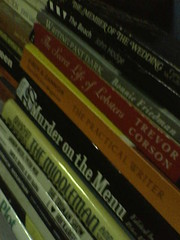
Lookie at the my new purchases! Haven't bought this many books since the start of the year, effectively repealing my self-imposed book ban. But it's not so bad, as almost all of them are from Booksale. The most expensive of the bunch, Brokeback Mountain: Story to Screenplay, came from Powerbooks, and that's already after 60% off.
A lot of the new acquisitions are scriptbooks (4/13): There is the aforementioned Brokeback Mountain, which contains the original Annie Proulx short story which first appeared in The New Yorker, with essays on the transition from page to screen by Proulx and the screenwriters Larry McMurtry and Diana Ossana. All of them are united in the idea that (1) The film did not murder the original material and in fact added to it, (2) short stories, not novels, make for better adaptation materials.
Also got John Hodge's screenplay for The Beach, based on the novel by Alex Garland, Andrew Niccol's script for The Truman Show, and the script for I Heart Huckabees, which I haven't seen yet but will read anyway.
There seems to be a lot of script books floating in Booksale stores. I wasn't able to get the triptych by Mike Figgis. Of the three, only Leaving Las Vegas was familiar to me. But still, I have ended up with a lot of books to read.
Also got books about writing: Writing Past Dark by Bonnie Friedman, The Practical Writer by Therese Eiben and Mary Gannon of Poets & Writers Magazine, and The Elements of Fiction Writing: Plot from the Writer's Digest Books.
Trevor Corson's The Secret Life of Lobsters is the lone nonfiction book not related to the craft of writing. I was hoping to find a copy of David Foster Wallace's Consider the Lobster. But hey, this is still about lobsters.
And the last bunch of books are all fiction. Two issues of Story Magazine (Winter 1997 and Spring 1999) cost me Php25 combined. Also got Carson McCullers' The Member of the Wedding and Bharati Mukherjee's The Middleman and other stories. Then there's Murder on the Menu edited by Peter Haining. This last one contains crime stories by Ruth Rendell, Patricia Highsmith, Agatha Christie, P.D. James and even Roald Dahl. Enlisted myself in the crime fiction writing class this term, so this will form part of my reading list.
All told, the thirteen books unloaded me of Php800. Not too bad. But then again, will probably impose the book ban again and not buy anything until I've read most of them.
A lot of the new acquisitions are scriptbooks (4/13): There is the aforementioned Brokeback Mountain, which contains the original Annie Proulx short story which first appeared in The New Yorker, with essays on the transition from page to screen by Proulx and the screenwriters Larry McMurtry and Diana Ossana. All of them are united in the idea that (1) The film did not murder the original material and in fact added to it, (2) short stories, not novels, make for better adaptation materials.
Also got John Hodge's screenplay for The Beach, based on the novel by Alex Garland, Andrew Niccol's script for The Truman Show, and the script for I Heart Huckabees, which I haven't seen yet but will read anyway.
There seems to be a lot of script books floating in Booksale stores. I wasn't able to get the triptych by Mike Figgis. Of the three, only Leaving Las Vegas was familiar to me. But still, I have ended up with a lot of books to read.
Also got books about writing: Writing Past Dark by Bonnie Friedman, The Practical Writer by Therese Eiben and Mary Gannon of Poets & Writers Magazine, and The Elements of Fiction Writing: Plot from the Writer's Digest Books.
Trevor Corson's The Secret Life of Lobsters is the lone nonfiction book not related to the craft of writing. I was hoping to find a copy of David Foster Wallace's Consider the Lobster. But hey, this is still about lobsters.
And the last bunch of books are all fiction. Two issues of Story Magazine (Winter 1997 and Spring 1999) cost me Php25 combined. Also got Carson McCullers' The Member of the Wedding and Bharati Mukherjee's The Middleman and other stories. Then there's Murder on the Menu edited by Peter Haining. This last one contains crime stories by Ruth Rendell, Patricia Highsmith, Agatha Christie, P.D. James and even Roald Dahl. Enlisted myself in the crime fiction writing class this term, so this will form part of my reading list.
All told, the thirteen books unloaded me of Php800. Not too bad. But then again, will probably impose the book ban again and not buy anything until I've read most of them.
Sunday, November 4
The Old Blue
“Girl Meets Boy,” Ali Smith’s modern retelling of Ovid’s Iphis myth, appears in The Guardian. An excerpt:
“I had simply never found anyone so right. Sometimes this shocked me so much that I was unable to speak. Sometimes when I looked at her, I had to look away. Already she was like no one else to me. Already I was fearful she would go. I was used to people being snatched away. I was used to the changes that came out of the blue. The old blue, that is. The blue that belonged to the old spectrum.”
“I had simply never found anyone so right. Sometimes this shocked me so much that I was unable to speak. Sometimes when I looked at her, I had to look away. Already she was like no one else to me. Already I was fearful she would go. I was used to people being snatched away. I was used to the changes that came out of the blue. The old blue, that is. The blue that belonged to the old spectrum.”
Tuesday, March 13
Napkin Fiction
Contrary to the first impression, this isn't really short fiction written on, uhm, feminine products. Nyahaha.
Esquire mailed table napkins to 250 writers and asked them to write stories on it. Takes off from that often repeated romantic notion that writers hang out in cafes, daydream, stare into the wide blue yonder, scribble magic words on paper, and voila! (or as a student of mine once said, "Wala!") A story is born.
I haven't read all the entries yet, but there are stories from Rick Moody and A.M. Homes.
Curious things: There's a writer included in the project called "Bud Wiser." Ha-ha. And I wonder if "Ethan Pacquin" is what Ethan Hawke will be called if he--by some strange twist of fate--marry Anna Pacquin. Gah.
Swiped from twisted
Esquire mailed table napkins to 250 writers and asked them to write stories on it. Takes off from that often repeated romantic notion that writers hang out in cafes, daydream, stare into the wide blue yonder, scribble magic words on paper, and voila! (or as a student of mine once said, "Wala!") A story is born.
I haven't read all the entries yet, but there are stories from Rick Moody and A.M. Homes.
Curious things: There's a writer included in the project called "Bud Wiser." Ha-ha. And I wonder if "Ethan Pacquin" is what Ethan Hawke will be called if he--by some strange twist of fate--marry Anna Pacquin. Gah.
Swiped from twisted
Subscribe to:
Posts (Atom)