Showing posts with label truman capote. Show all posts

Monday, February 9

Harlan, Truman, Lobsters and Sliced Bread

Was just going to buy a loaf of bread last night and I ended up with a loaf of bread, a comic book and a hardbound edition of Truman Capote's essays.

Have fallen in love with the wheat loaf from the store down the load. But when we dropped by last night, it was a full house but the bread counter displayed a lack of loaves, only pan de sal. The cashier checked in the pantry and said she'll have some sliced. Told her will come back in 10 minutes.

Browsing at National Bookstore can never be quick, and the ten minutes turned into thirty. But look at what I found:


On the left is Harlan Ellison's Vic and Blood, which collects all the "A Boy and His Dog" stories and Richard Corben's comic book adaptations. Beside it is a hardbound edition of the collected essays of Truman Capote, which I got for Php120 pesos. Not bad considering that's like 10% of the actual cover price.

The best thing about this is that they're on sale, with more than 80% markdowns:


I have yet to start reading them because right now, lobsters command my attention:

Monday, October 13

Capote and Genius

"Dearest Cecil," wrote Truman Capote from Brooklyn on April 19, 1965, addressing his friend, the English photographer and bon vivant Cecil Beaton. "This is just an exhausted scrawl (you owe me a letter anyway), but I wanted you and Kin to know the case is over and my book is coming out next January. Perry and Dick were executed last Tuesday. I was there because they wanted me to be. It was a terrible experience. Something I will never really get over."

The letter is among those collected in "Too Brief a Treat: The Letters of Truman Capote", which Richard Rayner reviews for the LA Times. The book is considered to be the most important Capote book since In Cold Blood, for it shows us through his various correspondences the demands exacted by his desire to be known as a writer and as a part of the social elite. He did get what he wanted, but with a major tradeoff. In his later years, Capote had too much drugs and drink and was never ever to capture the same litheness of prose he exhibited in In Cold Blood.

But that novel was sheer genius, and "Capote believed that he had "access" to genius himself but knew too that for him "genius" was not an all-encompassing, God-given blanket, but a state of talent and mind that could be earned, or worked toward -- and lost. Such a story arc is, in a way, the subtext of this entire collection."

Rayner adds: "It's customary to posit that Capote was a victim of the celebrity he craved, but there was something heroic about him too, for he polished his craft and sacrificed his peace of mind and moral equilibrium for the production of one supreme book, a grim and enthralling exploration of death and evil."

It seems like a sad ending. But for me, to have produced even just one "supreme book" is already a tall order. Yun nga lang, to lose one's peace of mind and be consumed by genius and the demands of craft is something that one must be prepared to do.

Wednesday, February 7

Conversations with Capote

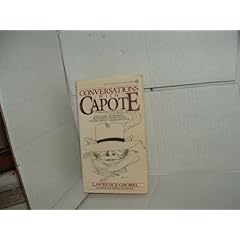
Conversations with Capote by Lawrence Grobel

I started reading Lawrence Grobel's Conversations with Capote (Book #3) initially to get material for a paper on writers who crossed over to screenwriting. The book has been lounging in my shelf for such a long time now, and it wasn't for the paper, I wouldn't have cracked it open. Now I wish I did so earlier. I started reading it on the train home and didn't put it down until I finished it several hours later.

Truman Capote's In Cold Blood is one of my favorite books, and it's not entirely accidental that the book is about a very masterful account of a massacred family in the American midwest in the 1950s. He had this literary brawl with Norman Mailer, who hired researchers and wrote The Executioner's Song without actually talking to the subject. That got Capote railed about him, and he said that Mailer would never write anything that would be remembered in twenty years or so down the road.

But by the time the conversations with Grobel had taken place, Truman Capote had sort of devolved into a semi-regular talk show guest, the kind whose every syllable would turn out to be controversial.

Here's a photo that appeared in the book:
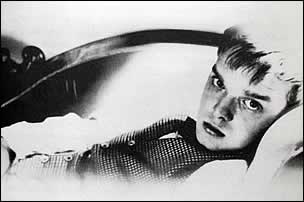
Ultimate ditz comment: Gosh, he's so hot! I suppose now there's no doubt that I am such a fag hag.

This was my first time to see this photograph of Capote; and I suppose, like everyone else, I was mesmerized by this photo of the reclining young man. A friend and I had this debate about which celebrity Capote resembled in his youth. I thought it reminded me of local actor Dingdong Dantes (terrible, I know), while my friend suggested a mix of Jack Black and Ewan McGregor.

At any rate, it was a controversial photo, one that catapulted Capote to the best seller list and made him a literary star. Wikipedia points us to Gerald Clarke, who in his Capote: A Biography (1988), wrote: "The famous photograph: Harold Halma's picture on the dustjacket of Other Voices, Other Rooms (1948) caused as much comment and controversy as the prose inside. Truman claimed that the camera had caught him off guard, but in fact he had posed himself and was responsible for both the picture and the publicity."

It's also this photo which made Andy Warhol become "madly in love" with Capote. Somewhere in the book, Capote says: "When he was a child, Andy Warhol had this obsession about me and used to write me from Pittsburgh... When he came to New York, he used to stand outside my house, just stand out there all day waiting for me to come out. He wanted to become a friend of mine, wanted to speak to me, to talk to me. He nearly drove me crazy."

Elsewhere, the photographer responsible for this photo recounted walking on Fifth Avenue. Halma overheard two middle-aged women looking at a Capote blowup in the window of a bookstore. When one woman said, "I'm telling you: he's just young," the other woman responded, "And I'm telling you, if he isn't young, he's dangerous!"

As for me, I just think that the photo just did what it needed to do: get people interested in the writer. Perhaps his youth had something to do with it. Pero naman di ba, if you're going to have an author photo na rin lang, it better be something as hot as this. So all in all, panalo ang Lolo Truman dito.